

A Thousand Dumb Dogs
And A Subtle Apostasy

Here’s how theories work:
You gather the data you wish to explain.
You see how well different stories explain them.
You provisionally endorse the story that explains them best.
Let’s gather our data, then. On the eve of the Reformation, every Christian Church in the world, from India to Ireland, held to some version of the following doctrines:1
Scripture includes at least the 73 books recognized by Catholics and Eastern Orthodox.2
Tradition handed down from the Apostles is a source of revelation.3
Mary never committed any sins.4
Mary was a perpetual virgin.5
Mary was assumed bodily into heaven at the end of her life.6
We can ask the saints to pray for us, and they may intervene with miracles.7
Christians on earth have a duty to pray for the Christian dead.8
There are seven sacraments, understood how Catholics, Eastern Orthodox, Oriental Orthodox, and the Assyrian Church of the East understand them today. This is a big-ticket item. It includes baptism for the forgiveness of sins and impartation of the Holy Spirit, confession to a priest for absolution from sins committed after baptism, Holy Orders/Ordination as a permanent mark upon the soul of a man empowering him to celebrate the other sacraments and join the divinely-instituted hierarchy of the Church, and the Eucharist after consecration as no longer bread and wine but the body, blood, soul, and divinity of Jesus Christ.9
Apostolic succession as a succession of bishops, not merely of beliefs.10
Justification as a lifelong process of transformation by the Holy Spirit, not a mere change of names or designations as per Luther. Instead, the moment of salvation was understood primarily as adoption to sonship.11
The veneration of relics and images.12
The liturgy taught by the Apostles as the center of Christian prayer and life.13
Here’s a plausible story for making sense of this data.
Following the death of Jesus Christ, wicked people persecuted and killed many Christians. Others drifted from the principles taught by Christ and his Apostles. The Apostles were killed, and the Church was tasked with maintaining fidelity to the teachings left behind in their writings. Because the Church was no longer led by Apostolic authority, error crept into its teachings. Good people and much truth remained, but the gospel as established by Jesus Christ gradually, perhaps by imperceptible degrees, became unrecognizable.
This piecemeal apostasy resulted in the formation of many churches with conflicting teachings. During this time, many men and women sought the truth, but they were unable to find it. Many good people believed in God and Jesus Christ and tried to understand and teach truth, but they did not have the full gospel or biblical grounding. As a result, each generation inherited a state of apostasy as people were influenced by what previous generations passed on, including changes to Christ’s gospel.
Yet God knew there would be an apostasy. Through an Old Testament prophet, He said:
Behold, the days come … that I will send a famine in the land, not a famine of bread, nor a thirst for water, but of hearing the words of the Lord:
And [people] shall wander from sea to sea, and from the north even to the east, they shall run to and fro to seek the word of the Lord, and shall not find it. (Amos 8:11–12)
Some inspired people, such as Martin Luther and John Calvin, recognized that practices and doctrines had been changed or lost. They initiated a reform in the Church to which they belonged. Their descendants have continued this reform down to the present day.
It seems reasonable enough. This story looks at the data I gathered above, then judges it the natural result of a slow and steady drift, a kind of liturgical telephone in which each successive generation gets a little more confused, until the whole thing is a morass of haphazard man-made religion.14 Presumably the advent of the printing press marks the turning point, for it means that the game of telephone can end. We have a recording of the original message, so to speak, and are now in a position, perhaps for the first time, to make it the direct basis for Christianity. Gutenberg is like a new Josiah, handing us tools to cut away the husk and retrieve the kernel, to chip away the accretions and reveal the pristine face of Christ hidden under so much hardened muck.
But here’s an interesting fact. The italicized text, with a few minor alterations to avoid giving the game away, is taken directly from the Church of Jesus Christ of Latter-day Saints website. Strange bedfellows indeed.
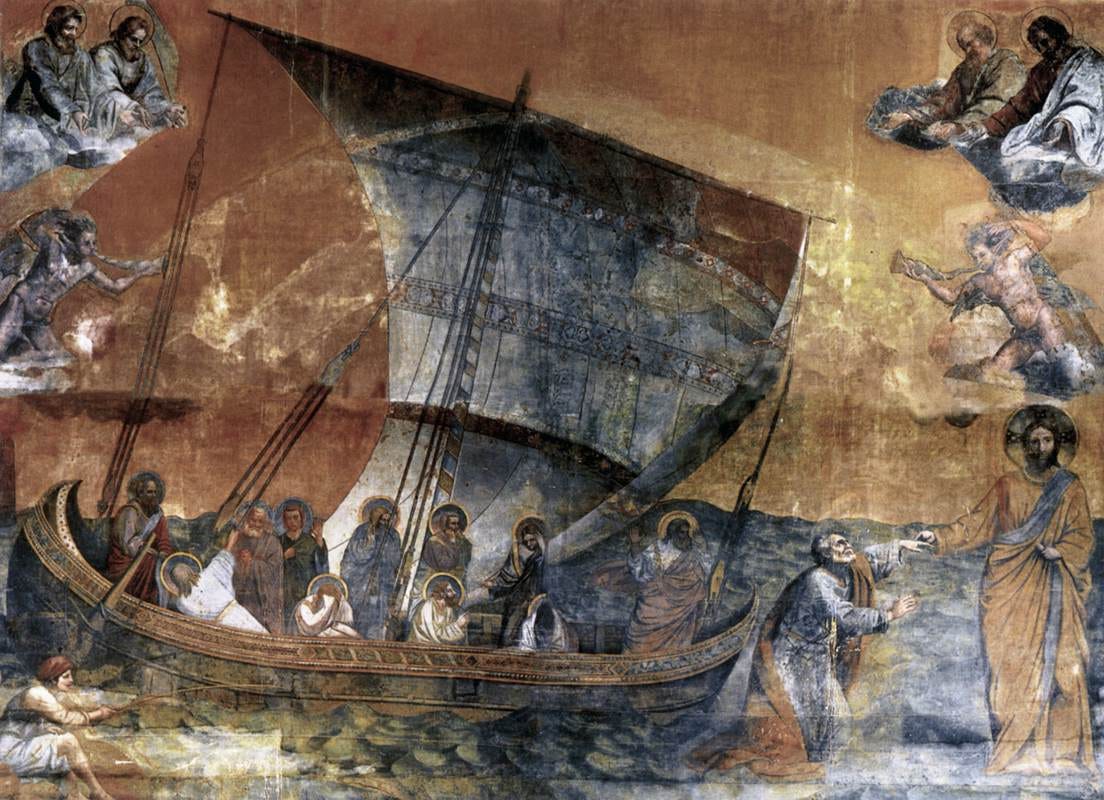
The first schism in Church history is almost quaint, in retrospect. During the reign of Pope Victor I, roughly 189-199 A.D., a fierce debate erupted between the churches in Asia and the Bishop of Rome over how to determine the date for the Easter Mass. The Asian churches calculated it according to the reckoning of the Jewish Passover, regardless of which day of the week it fell on, while the Roman church, along with most of the rest of the Christian world, always celebrated it on a Sunday.15
Technical. Dull, even. But remember: these people were obsessed with Jesus Christ. They cared passionately about seeming trifles because they didn’t want to let a single drop from the fountain of the Gospel fall wasted to the ground. Into such an assembly, fevered with devotion to the point of martyrdom and twitching with vigilance against the incursion of heresy, the Subtle Apostasy story invites us to imagine that someone (who?) first murmured, perhaps in a voice pitched low with deference, “Hey, we’ve been just praying to Jesus so far… What if we added Mary?” And then everyone, everywhere, adopted it instantly without question or comment.
Okay maybe it didn’t happen exactly like that. But the point is this: If the Subtle Apostasy story is true, then there was some definite point at which the creep of heresy went from zero to one. And not just once. The Subtle Apostasy story requires that, again and again, bizarre aberrations were introduced and universally accepted without a shred of protest.
What if I tried this today? What if I walked into a Baptist, or Anglican, or Lutheran, or Presbyterian church and meekly suggested that maybe we have our sick touch the bones of the founding pastor and see if it heals them. I’d even have biblical precedent!16 I don’t imagine I would have much success, let alone be invited to teach Sunday School. But that’s exactly what the Subtle Apostasy story requires us to say happened. Who has the strength to believe that the Church freshly founded by Jesus Christ and recently ruled by the Apostles would be easier to subvert than your preferred modern Protestant church?
Suppose I did succeed in creating a band of bone-kissing Baptists. Would the development pass without a single written comment from the pastor? Without a measly one sermon celebrating our new reliquary? But again, that’s precisely what the Subtle Apostasy story tells us happened in the early Church. Christians everywhere, against the teaching of the Apostles, accepted the early versions of what would develop into the practice of Christians at the dawn of the sixteenth century. And no one said a thing.
We know from the Easter dating controversy that they cared—a lot—about getting Christianity right. We know from the works surviving to us that the theologians of the first several centuries were highly sophisticated. So they weren’t too apathetic or too stupid to detect problematic doctrine. And it won’t work to say that they didn’t notice it because they were trained to ignore the cognitive dissonance from a young age; the entire Subtle Apostasy story turns on the idea that all the things listed above were not actually taught by the Apostles, that there was a distinct time when no Christians believed those doctrines, and a later time when they were normalized, global, and completely integrated into Christian teaching.
I’m no Sherlock, but something seems off.
Fortunately, I don’t need to be Sherlock. Sir Arthur Conan Doyle himself has left us with a perfect analogy for the situation. In The Adventure of Silver Blaze, Sherlock observes one such conspicuous silence:
Gregory (Scotland Yard detective): Is there any other point to which you would wish to draw my attention?
Holmes: To the curious incident of the dog in the night-time.
Gregory: The dog did nothing in the night-time.
Holmes: That was the curious incident.
The dog didn’t bark because the intruder was someone the dog knew well and expected to be in the house: its owner. Likewise, the early Church had no controversies over the doctrines I outlined above because they were already inside, put there by our own Master. To be extremely clear, the argument is NOT that the Church couldn’t have been wrong on such a large scale for so long. It’s that if these doctrines were not original, there would be no way for them to be introduced and widely adopted without comment.17
The insurmountable problem for any version of the Subtle Apostasy story, no matter how gradual the slope to infidelity is made to be, is that the Church has always been populated by hundreds, even thousands, of watchdogs. When the first person suggested that Mary might have been free from personal sin, or that Sirach be counted along with Proverbs as Scripture, or that priests were deputized by Christ to hear and forgive sins, not a one of them raised the alarm—not even a whimper.18 What a strange bunch this makes early Christians out to be: one bishop questions the practice of calling Mary the Mother of God, and the whole world gathers to answer him. But when Christians of every tongue begin calling upon her for aid—something I have been assured by strangers in coffee shops and bus stops is sheer idolatry—it escapes the notice of every preacher and theologian.
In the course of this argument, I have left out (or shoved into footnotes) a great many things that would help my case. To attend to them would distract from the main point: The Subtle Apostasy story just cannot capture the data. It should be scrapped for something that sits more easily atop the throne of history. Here is one such story: the “accretions” are not accretions at all, but original elements of Christianity. The same men who defined the canon of Scripture, worked out the doctrine of the Trinity, the Incarnation, and much more, did not suddenly become incompetent when they turned their attention to other areas of no small concern. In other words, it’s all original, baked into the Last Supper and built into the threshold of the first cathedral.
It’s elementary.
Read Part II here:

This is effectively two essays interwoven. The footnotes have technical details and citations. The main text is kept clear for the primary argument. It is probably best to read the post through without footnotes, then go back and read the ones that interest you. If you try to do both footnotes and main text at once, I suspect you’ll get too bogged down to finish. On a related note, you’ll want to open it in your browser to read the whole thing; it ended up exceeding the email length limit.
A point of terminology off the top: “Church” is used in two ways. It can refer to 1) the Catholic Church, the global collection of believers organized under the hierarchy led by bishops, and 2) particular Churches, internally governed segments of the Catholic Church usually running along national or ethnic lines. Internal governance is not absolute but is subject to the Universal Pastor, the Bishop of Rome. This universal headship over the Church on earth is why the Pope is sometimes called the “principle of unity” in the Church; he unites the hierarchies that would otherwise top out at the cultural or political level. So, when I refer to the Greek Church, for example, that need not imply non-Catholic. It’s just the portion of the Catholic Church that took root in the Greek-speaking world.
There is one hitch. History has introduced many sad divisions among us, so that there are now particular Churches out of communion with the Catholic Church. Although tragic in itself, this actually serves my argument in an important way: it provides independent confirmation of the ancient status of Catholic belief, as we shall see in the next footnote.
We can know this for several reasons.
First, because the first time the question of the canon was raised to the level of official Church treatment was in 393 A.D. (curiously late if the early Church held to sola scriptura) and came up with the exact books used by Catholics today. The Eastern and Oriental Orthodox ended up with a little more, but that’s not our present concern. There is a good, short Wikipedia article here. (Do note, in passing, that the 393 A.D. list was finalized pending the approval of Rome.) This was never disputed by another Christian Church, which would signal that no one found it objectionable.
Second, because there are four Christian communions coming down to us from the Apostles: the Catholic Church, the Eastern Orthodox Churches (split 1054 A.D.), the Oriental Orthodox Churches (split 451 A.D.), including most notably the Ethiopian Tawahedo Church and the Coptic [that is, ancient Egyptian] Church), and the Assyrian Church of the East (p. 20, #7) (split 381 A.D.) After they split, each of these went its own way, meaning that their development was independent; thus whatever you find in all of them can be traced back to the pre-split era with extreme confidence. More to the point, their teaching certainly hasn’t changed in the last 500 years. They all pride themselves on accepting no doctrinal development after their point of departure. Indeed, in every case it was precisely doctrinal development that led to the schism. I’ve hyperlinked each Church’s name above to sites where you can see for yourself that they accept the disputed books today.
Third, and some of those websites mention it, the Bible of the early Church was the Septuagint, a major Greek translation of the Old Testament. Every copy of the Septuagint we have contains the books rejected by Luther at the Reformation. Not only that, but one reason the ancient Jews rejected the Septuagint around 90 A.D. was that it was tainted by Christian association! If you don’t believe me, here is a myjewishlearning.com concurring:
“Although the Books of Maccabees were not included within the Hebrew Bible, they are still of value. Yet even this is difficult within a traditional Jewish context, due to another historical layer. First and Second Maccabees were included in the Septuagint, the Greek translation of the Hebrew Bible originally prepared for the Jewish community of Alexandria. However, the Septuagint became the official version of the Bible for the nascent Christian Church. When this happened, its authoritative nature was rejected by the Jewish community. Ironically, the Books of Maccabees survived because they became part of the Christian canon, for otherwise they most certainly would have been lost during the centuries. But once this Christian canonization occurred, these books became lost to the Jewish world for many centuries.” (Emphasis added)
From the Catechism of the Catholic Church:
§76 “In keeping with the Lord’s command, the Gospel was handed on in two ways:
orally “by the apostles who handed on, by the spoken word of their preaching, by the example they gave, by the institutions they established, what they themselves had received - whether from the lips of Christ, from his way of life and his works, or whether they had learned it at the prompting of the Holy Spirit”;
in writing “by those apostles and other men associated with the apostles who, under the inspiration of the same Holy Spirit, committed the message of salvation to writing”.
. . . continued in apostolic succession.”
From the Greek Orthodox Archdiocese of America:
“…the message of salvation originating from God the Father was taught by Jesus Christ, witnessed to by the Holy Spirit, preached by the Apostles and was transmitted by them to the Church through the clergy they themselves appointed. This became the "unerring tradition of the Apostolic preaching" as it was expressed by Eusebius of Caesarea, bishop of the fourth century, who is considered the "father" of Church History (Church History, IV, 8).”
From a resource supplied by the Coptic Orthodox Metropolis of the Southern United States, itself adapted from the work of a Coptic patriarch (whom they also refer to as a pope):
“Our Lord Jesus Christ did not write a book, He did not document His blessed teachings on paper, but He chose His disciples who accompanied Him day and night. They absorbed His teachings and learned directly from Him. He sent them to teach the whole world and to make disciples of all nations, “Go therefore and make disciples of all nations.” (Mt 28:19) Making disciples is based primarily on direct contact with the person and on verbal teaching […]
Christianity is, therefore, a religion that is Tradition-bound and is strongly committed to discipleship. No wonder, then, that the Apostles preferred verbal teaching to the written one.” Emphasis in original.
From the Catechism of the Assyrian Church of the East:
“All the truths proclaimed from the lips of our Lord and Savior Jesus Christ, and of the Apostles have been recorded for us, in both the Sacred Tradition and in the Sacred Writings. The Sacred Tradition practiced by the early Apostles and Church Fathers had been handed down to us unto this present day…” (p. 4)
If you thought my citations would let up here, think again. Although there is some debate about the nuances of this doctrine as it’s developed in the Catholic Church, we all agree on the basic premise. Let the parade begin.
[Eastern] Orthodox Church of America:
“Mary was not forced to be holy but freely chose to live in perfect harmony with God. Her life was one of prayer and surrender. She grew in holiness by uniting her will with God’s will, showing that sinlessness is not separation from humanity but its fullest healing.
As the Orthodox Church explains, Mary was not born exempt from the fallen world, yet she never committed personal sin. Her holiness was the result of divine grace received through her faith and obedience.” Emphasis added.
For the Coptic Church, I couldn’t find anything more official than a Q&A post from the Coptic Orthodox Diocese of the Southern United States, most of which was dedicated to distinguishing the Coptic view from the Catholic view. There is, however, this very clear statement:
“She is the perfect person, the Holy Spirit overshadowed her and our Lord entrusted her with Him.” Emphasis added.
The Coptic Orthodox Diocese of Los Angeles, Southern California, and Hawaii refers to her as “pure” 14 times on their page dedicated to Marian theology, including especially the title “All pure Saint Mary.”
Assyrian Church of the East:
“Blessed Mary was called full of grace because she lived her entire life in holiness according to the commandments of God. She knew her place in the plan of salvation. As a normal human being, blessed Mary has a human body which always has a tendency towards sin. So even though she is pure and has never committed sin in her life, yet she knew, as a human being she is in need of a Savior.” (p. 146) Emphasis added.
“Again, in the following anthem, we are recognizing that the fathers of the church are repetitively using those words[, for example, “pure,”] which directly describe the immaculate status of the Virgin Mary.” (p. 149) Emphasis added.
The most important Ecumenical Council of the early Church was the Council of Chalcedon in 451 A.D. It was here that the Fathers hammered out the doctrine of the two natures of Christ, laying down what Protestants and Catholics alike today look upon as the touchstone for orthodoxy. The Council’s theological architect was Pope Leo I, who unilaterally overturned a false Council three years earlier that attempted to assert that Christ had only one nature. His word on the subject, which became known as the Tome of Leo, was the primary theological source for Chalcedon. Every Protestant, every Catholic, every Eastern Orthodox today owes their understanding of Christ to Leo the Great. He is no heretic, he is no fool. With that in mind, read his own words:
“The origin [of the conception of Christ] is different [from most humans,] but the nature like: not by intercourse with man but by the power of God was it brought about: for a Virgin conceived, a Virgin bare, and a Virgin she remained.” Sermon 22. Emphasis added.
This wasn’t the only Ecumenical Council touched by the doctrine. The Fifth Ecumenical Council just says it outright:
”If anyone will not confess that the Word of God has two nativities, that which is before all ages from the Father, outside time and without a body, and secondly that nativity of these latter days when the Word of God came down from the heavens and was made flesh of holy and glorious Mary, mother of God and ever-virgin, and was born from her: let him be anathema.” “Against the Three Chapters,” Anathema 2. Emphasis added.
The same thought is reiterated in two other anathemas, 6 and 14.
It’s present much, much earlier, though. Hippolytus of Rome (170 A.D.-235 A.D.), who has the unique distinction of bearing the titles ‘First Antipope,’ ‘Martyr,’ and ultimately ‘Saint’ (sequentially; he was reconciled to the Pope of Rome during a round of persecution and readmitted to the Church before they both gave their lives for the Gospel together), is also one of the earliest theologians of the Trinity. Even a Protestant publisher like Zondervan is happy to acknowledge it. So, like Leo I, he’s no slouch, and we all probably owe something of our understanding of the Trinity to him. It should matter, then, when he turns his attention to Mary and says:
“But the pious confession of the believer is that, with a view to our salvation, and in order to connect the universe with unchangeableness, the Creator of all things incorporated with Himself a rational soul and a sensible body from the all-holy Mary, ever-virgin, by an undefiled conception, without conversion, and was made man in nature, but separate from wickedness: the same was perfect God, and the same was perfect man; the same was in nature at once perfect God and man. In His deity He wrought divine things through His all-holy flesh…” Against Beron and Helix, Fragment VIII. Emphasis added.
Notice, while we’re looking at it, that the same adjective is used for the humanity of Mary and Christ: “all-holy.” It would seem to designate sinlessness.
And let’s not forget the ancient theologian most revered by Protestants, St. Augustine himself:
“It is not this visible sun, but its invisible creator, who has consecrated this [Christmas] day, when the virgin mother gave birth from her fertile and unimpaired womb to the one who became visible for us, by whom in his invisibility she herself was created; a virgin in conceiving, a virgin in giving birth, a virgin when with child, a virgin on being delivered, a virgin for ever.” Sermon 186. Emphasis added.
But did the Churches accept this? Have they continued to believe it down to the present day? We can already answer for the Catholics and Eastern Orthodox, since they hold the Fifth Ecumenical Council to be infallible. But what about those who split earlier, namely, the Oriental Orthodox and the Assyrian Church of the East? Let’s see.
We’re back to the Coptic Orthodox Diocese of LA, etc., for this one:
“Another prophet confirms St. Mary’s perpetual virginity, as he says:
‘When he brought me back the way of the gate of the outward sanctuary which looked towards the east, it was shut. Then the Lord said to me: This gate shall be shut, it shall not be opened, and no man shall pass through it, because the Lord, the God of Israel, has entered by it, therefore it shall be shut. It is for the prince; the prince himself shall sit in it…’ (Ezk. 44: 1-3).
This sealed eastern gate is a figure of St. Mary’s perpetual virginity. For the Lord alone entered her womb, and this gate was never opened to another; its seals were not broken.” Emphasis added.
The Assyrian Church of the East has several documents on Mary, collectively longer than their entire catechism (the English version, at least). One says the following:
“Saint Mary the ever virgin, has a high and exalted place in The Church of the East. Fathers of the Church believe Virgin Mary has acquired a unique rank of veneration above all the rigtiouse [sic] people merely because God desired to make His divine power to rest upon her.” (p. 2) Emphasis added.
But I won’t stop there. Even Reformers affirmed it! Behold ReverentLutheran.com giving a tour de force of Lutheran doctrinal sources. Calvin was agnostic on it, but took pains to reject the standard Protestant arguments against it (see here). Zwingli believed in it: “And I believe that this humanity was conceived ofthe virgin, made pregnant by the Holy Spirit, and was broughtforth by preserving her perpetual virginity…”
I found this here, but did go and check the primary source (p. 244) for accuracy.
This one will be easiest to show by noting that all the relevant Churches have feast days dedicated to the Assumption of Mary. A feast day is an official Church holiday (holy-day…) celebrating some person or event important to Christianity. Every saint has a feast day, but so do many of the key moments from salvation history. Ending up on the Church calendar is more than a tacit endorsement. It means the Church is officially convening the faithful to celebrate the Sacred Liturgy in gratitude for the person or event. It’s a big deal. So, a dedicated feast day can be taken straightforwardly as proof of a Church’s official belief.
Note: there is a minor dispute over whether Mary “fell asleep,” i.e., died, first and then was assumed into heaven (this is called the Dormition), or was directly assumed into heaven without dying (one thinks of St. Paul: “Behold, I tell you a great mystery: we shall not all sleep, but we shall all be changed” 1 Cor. 15:51). I’m going to use “Assumption” as the name for the broader view because both agree that her body was assumed into heaven; they just disagree whether she had died first. The Catholic Church permits both views.
Catholics celebrate the feast on August 15.
Eastern Orthodox celebrate the feast on August 15.
The Coptic Orthodox celebrate the feast on August 22.
The Ethiopian Orthodox celebrate the feast on August 21.
The Assyrian Church of the East celebrates the feast on August 15.
Unfortunately, in the Assyrian Church of the East’s digital calendar, the feast is simply labelled the “Commemoration” of Mary. So in lieu of an epic one-click citation, enjoy this lovely post of the Assyrian Church of the East celebrating the Assumption with Chaldean Catholics, the chunk of their ancient Church that is in communion with the Catholic Church.
For good measure I’ll add a reference from their primary document on Mary:
“His Holiness Mar Ignatius Zakka 1 Iwas in an article [titled,] “The Holy Virgin Mary in the Syrian Orthodox Church” [s]ays: “Her Assumption in the flesh and soul was not instituted by the Syrian Church as a doctrine. The Virgin’s Assumption is a confessional patristic tradition.” (p. 140)
The problem with this point is that there is TOO much evidence to reasonably condense it down. Instead of thoroughly exploring the doctrine of the intercession of the saints in all four major Apostolic communions, let’s aim for something more minimal: to establish that each Church does in fact call upon saints, and one or two reasons to think it is an extremely early practice.
Here’s the Catholic evidence: St. John Henry Newman, pray for us!
For the others, let’s take excerpts from their official prayers so you can get a feel for the tenor of their attitude toward the saints.
Eastern Orthodox:
O most honored father John,
Robed in thy sacred vestments like Aaron of old
Thou standest now beyond the second veil of the Temple on-high
Beholding God, the Holy of Holies.
O the ineffable brilliance of thy mind,
O thou divine adornment of the hierarchs,
With whom thou art now joined in eternal fellowship
From September 2nd of Aorist Press’s Menaion (the schedule of liturgical prayers), based on the Russian Orthodox Menaion. The “John” in question was an archbishop of Constantinople.
Oriental Orthodox:
Hail to you. We ask
you, O saint full of glory,
the Ever-Virgin, Mother of
God, Mother of Christ
Lift our prayers, to your
beloved Son, that He may
forgive us our sins.
From the Coptic Agpeya (p. 140), their version of the Liturgy of the Hours.
Assyrian Church of the East:
The hallowing of the blessed Mar Theodore,
the Interpreter of the divine Scriptures—
may his prayer be upon the community of the faithful—
is ended with the help of our Lord.
From the Hallowing [Feast Day] of Mar [Holy] Theodore the Interpreter of the Divine Scriptures, Bishop of Mopsuestia (p. 10).
Although their catechism (p. 92-4) has an explicit defense of invoking the saints, it was hard for me to find a really good example from the Assyrian Church of the East in English; most of it is untranslated. I did, however, come across this description of their church architecture from an official instructional website that is very telling:
“The martyrium or beth sāhde was usually located further north of the nave alongside the northern wall and quasi parallel to the bemā; it was here that the procession ended after the liturgical prayer with the recitation of the martyrs’ anthems. The ‘house of the martyrs’ usually took the form of a small chamber to which one gained access by a door in the middle of the northern wall. In the shrine of the martyrs, the relics of the martyrs or of the saints rested, and it might also have contained the relics of the patron saint of the church or of the prelates, and might have originally been the burial place of the martyr.” (p. 21) Emphasis added.
We also have some early examples of Christians asking the saints for prayer. Here are two quick examples.
First, the Sub Tuum Praesidium:
We fly to thy protection,
O Holy Mother of God;
Do not despise our petitions
in our necessities,
but deliver us always
from all dangers,
O Glorious and Blessed Virgin.
The Wikipedia article grudgingly acknowledges that this prayer was in liturgical use in the fifth century, and is found in all of the liturgical languages of the early Church. Which means that it was widespread and normalized enough to get into the official prayers of the Church completely uncontroversially by the 400’s A.D.
Second, an amulet discovered in 2024, dated to the middle of the 200’s A.D. was found to contain a tightly rolled scrap of parchment with a prayer invoked in the name of “Saint Titus.”
If you need more convincing, just look at how all four of our ancient communions treat Mary. She is a special saint, but a saint still—if you can call upon her and depend upon her intercession, the same goes for other saints. Consider also the universal practice of naming churches after saints or passing down miraculous stories from their lives.
The Eastern Orthodox funeral liturgy contains several prayers that God grant rest to the faithful departed. This prayer only makes sense if there is some process of purification for Christians after death, readying them to fully enter the joys of heaven:
With the Saints give rest, O Christ, to the soul of Your servant where there is no pain, nor sorrow, nor suffering, but life everlasting.
The Coptic Orthodox funeral liturgy has the following:
This soul that we are gathered for, O Lord, repose it in the kingdom of heaven.
Open for this soul, O Lord, the doors of Heaven.
Accept it unto You according to the greatness of Your mercy.
Open for it, O Lord, the doors of righteousness, so it may enter and find comfort there.
Open for it, O Lord, the doors of Paradise, as You opened it to the thief.
Open for it, O Lord, the doors of kingdom, so it may share with the saints.
Open for it, O Lord, the doors of rest, so it may chant with all the angels.
Let it be worthy to see the delight.
Let the angels of light enter it into the life.
Let it be in the bosom of our fathers Abraham, Isaac, and Jacob.
Rites Book I - Funeral Liturgies, Laity (p. 34)
In fairness I must add that the same document I found this in contains an introduction that is at pains to deny the Catholic doctrine of purgatory. What it articulates instead, though, is vague at best. It certainly shies away from endorsing instantaneous beatitude (the Protestant view). At the end of the day, I think it is simply impossible to understand pleading with God to accept a Christian soul speedily without implying something very roughly like purgatory. But in the interest of modesty, I restricted the claim in the main text merely to prayers for the dead, so I’ve already done my bit there.
The Assyrian Church of the East Funeral Liturgy has:
With all Your saints, O King Christ, Let the soul of your servant rest in peace. Where grieving does not rule; neither suffering, nor sadness; only the promised Eternal life. (p. 12)
I’ll be honest. This is such an enormous topic that it could easily be several articles in itself. So in lieu of substantiating every sub-claim, I’ll direct you to my favorite website, churchfathers.org, and let you poke around for yourself. Here, I’ll just focus on the Eucharist. We’re looking for evidence that these Churches think that the Eucharist at the consecration during the liturgy ceases to be bread and wine and instead becomes Jesus Christ himself, full stop.
Greek Orthodox Archdiocese of America:
”Orthodoxy has clearly avoided reducing the Eucharist to a simple memorial of the Last Supper which is only occasionally observed. Following the teachings of both Scripture and Tradition, the Orthodox Church believes that Christ is truly present with His people in the celebration of the Holy Eucharist. The Eucharistic gifts of bread and wine become for us His Body and His Blood.” Emphasis added.
In this case the Oriental Orthodox are represented by the former head of the Coptic Church, His Holiness Shenouda II:
“You see in faith the bread and wine in front of you transform into the body and the blood of the Lord. Here you can not rely on your senses to judge, because the bodily senses see only the visible matters. But the spiritual senses heed to what the Lord says “This is my body... This is my blood” (Matt. 26:26,28).
I do not dispute what the Lord said but I accept it in faith.”
Assyrian Church of the East:
”[The liturgy] is one of the Sacraments of the Holy Church; it is the central focal point of our communal worship. It is within this worship that the worshiper receives under the species of bread and wine the Precious Body and Sanctifying Blood of our Lord and Savior Jesus Christ.” (p. 114) Emphasis added.
Note that “species” (in this case roughly meaning “mere appearance,” as in “specious” or “speculate”) is exactly the same terminology used by Catholics. In fact they sound very Catholic later on when they add:
”Yes, indeed, they are The Real Body and Blood of Jesus Christ! Jesus did not teach us that these are merely “the symbols of His Body and Blood” but, rather, The Real Body and Blood of Him who came “down for us and for our salvation;” for nowhere in all of the Holy Bible is there written any reference that these gifts of Jesus were a symbol or symbolic…” (p. 123)
You can see the Orthodox Church of America charting their recent apostolic succession here.
The Coptic Orthodox Diocese of the Southern United States says:
“Every single Orthodox bishop, presbyter, and deacon can trace his ordination, through the laying on of hands, directly back to the Apostles and, consequently, to Christ. It was not up to any person, no matter what gift of ministry he has, to just appoint himself as a pastor or be appointed by laymen.” Emphasis added.
And the Assyrian Church of the East concurs:
“The Church was established by our Lord’s commission to the Holy Apostles, and they in turn instructed the converts to This Way, the very words of our Lord Himself, which is the basis of Apostolic Sacred Tradition, Holy Dogma, the Holy Laying-on-of Hands in Apostolic Succession, which established the Holy Fatherhood of The Church through the Bishops, Priests and Deacons. The Apostolic Church of the East had been established by the very Apostles themselves, giving to us the traditional practices, sacramental observances, etc.” (p. 98) Emphasis added.
From the Greek Orthodox Archdiocese of the United States:
“The reception of the gift of salvation is not a one-time event but a life-time process…For Paul, Christians are involved in a lifetime covenant with God in which we work, planting and watering, but it is “only God who gives the growth” (1 Cor 3:7). We are “co-workers with God” (synergoi Theou, 1 Cor 3:9; 1 Thess 3:2). (Not “co-workers under God” as some translations would have it). The mystery of salvation is a duet, not a solo. It is a life-time engagement with God.”
Let’s have the Ethiopians represent the Oriental Orthodox communion this time:
“Salvation is a present experience consisting in man’s complete confidence and communion with God as well as his perfect peace and harmony with his fellow beings. This sate [sic] of being which should be ours here and now should grow till it reaches its final culmination in the eternal realm. Thus salvation is a present reality which has a future reference.”
Assyrian Church of the East:
“3) What is essential in order to please God and to redeem one’s soul?
First: a knowledge of The True God, and to possess a right faith toward Him; and, Second: A simple life of faith (according to the gospel of Salvation) and good works.
…
5) Why must a life of faith and good deeds be considered inseparable?
Because it is written, ‘...faith without works is dead...’ (James 2:20)” (pp. 9-10)
Do not mistake this; none of these Churches hold that one can add anything to Christ’s work, but rather that justification is a real “setting right” or “straightening out” of what is bent in us. But as it happens, Protestants are not so far apart from Catholics and the other Apostolic Christians on this as it might seem. We’ve even got a Joint Declaration to prove it!
Eastern Christians, Orthodox and Catholic alike, have a deep and ancient practice of image veneration, particularly expressed by kissing them. St. John the Evangelist Orthodox Church’s website has a nice explanation:
“Orthodox Christians kiss icons and bow before them because Christ entered the world and made Himself a part of it; and that world He entered is good and holy. In this way, icons serve as windows into heaven, showing us the glory of Christ.
Moreover, we venerate icons with the understanding that veneration is not paid to the material object itself, but to the person or event represented in that icon ‘in spirit and truth’ (John 4: 24). The veneration given to the icon passes over, as Saint Basil says, to its prototype, causing those who look at them to commemorate and love and respect that person or event.” Emphasis added.
We’ve been hearing mostly from the Coptic and Ethiopian Churches to represent Oriental Orthodoxy. Let’s look to the Armenian Church for some variety. This comes from a priest with the Armenian equivalent of a doctorate in theology, describing the blessing of a holy image and its consecration for use in a church:
“According to father Sdepanos Man’tinyants, the painting should be cleaned during the service with water and wine, as a symbol of sanctification through the water and blood that shed from the left flank of our Lord Jesus Christ. The presiding priest chants and anoints the painting in the name of the Father, and the Son and the Holy Spirit. The hymn dedicated to the saint is sung and the priest pays his respect by incensing the sacred painting and kissing. In the end of the ceremony, all the faithful get the chance to kiss and pay their respect as well.” Emphasis added.
And lastly we turn again to the Assyrian Church of the East. I was able to dig up a patriarch of their Church, Catholicos Mar Elia II (reign 1111-1132 A.D.), on the subject:
“We use pictures in churches to work as language especially to those who do not know how to read or write, like kids or the illiterates. For example, if someone looks at a picture and meditate about it he would no longer need to ask question about the subject of it like the person who does not know how to read and ask someone else to read for him. And pictures in this matter have a preference more than anything else. Therefore, we venerate, accept and honor images, and it is all based on respect. Honoring them, kissing them and venerating them come in place of the honor pushed by our Muslim friends to copy their holy books. Kissing the icon is like talking to the people represented in the pictures.” (p. 17) Emphasis added.
The English is a little rough, but beggars (me) can’t be choosers. It is extremely interesting to me that Elia II thinks of obsession with texts as a distinctly Muslim disposition, while Christians venerate persons. The document elsewhere emphasizes that although the Assyrian Church of the East is sometimes thought to decline the use of icons, this is due only to the pressure of Islam over the centuries making icon production and use more difficult, not an authentic representation of their tradition (p. 1).
In The Divine Liturgy: A Commentary in the Light of the Fathers, Father Hieromonk Gregorios of Mount Athos (the center of Eastern Orthodox spiritual life) says this:
“The Divine Liturgy is the mystery of Christ. In it, things near and things far, the beginning and the end, co-exist side by side: ‘The Passover of the Lord appears, the ages are brought together [that is, differences of time are removed], heaven and the earthly world are made one.’ As Christ is Alpha and Omega, the first and last, the beginning and the end (Rev. 22:13), so the Divine Liturgy is the synaxis of space and time in Christ and their transfiguration into liturgical space and time.” (p. 16)
Emphasis and brackets in original. The quotation is from Letter to Diognetus 12.7.
From the Coptic Church:
“The Liturgy is the central and most important act in the Orthodox Church because we all stand before the throne of God participating together in prayer, teaching, worship, and finally receiving the Holy Communion, the true Body and Blood of our Lord Jesus Christ.”
The Ethiopian Church, another Oriental Orthodox Church, says it even more forcefully:
“The Holy Eucharist/Qiddasie - Holy Communion/Kiddus Qurban is the most sublime Mystery - Sacrament of our Church, the Mystery of Mysteries, The Sacrament of Sacraments. It is the eternal Sacrament whose value is incomprehensible and incalculable, and whose position in the worship of our Church is unique. The Holy Eucharist - Qiddasie is the centre of the Church’s life. It is the completion of all of the Church’s Mysteries - Sacraments, the source and the goal of all of the Church’s doctrines and institutions.”
Emphasis added because it sounds strikingly similar to this famous passage from the Catechism of the Catholic Church.
The Assyrian Church of the East concurs:
“The celebration of the Eucharist is the most perfect of all the sacraments, because it makes the paschal, [that is, Easter,] mystery of Christ present. All the redemptive events aim at this and proceed from it. Thus, the interpretations of the celebrations of the other mysteries lead to the interpretation of the celebration of the Eucharist: they are all in their own way an exposition of the Paschal Mystery of Christ. God’s plan of salvation is the common background for all liturgical celebrations. It turns out that their focus is on celebrating of the holy Mass, to which they are directed, in which they gather together and through which each has its own meaning.” (p. 14) Emphasis added.
Some readers will find this story very familiar, expressing exactly what they’ve been taught in church, perhaps with visuals like the following:
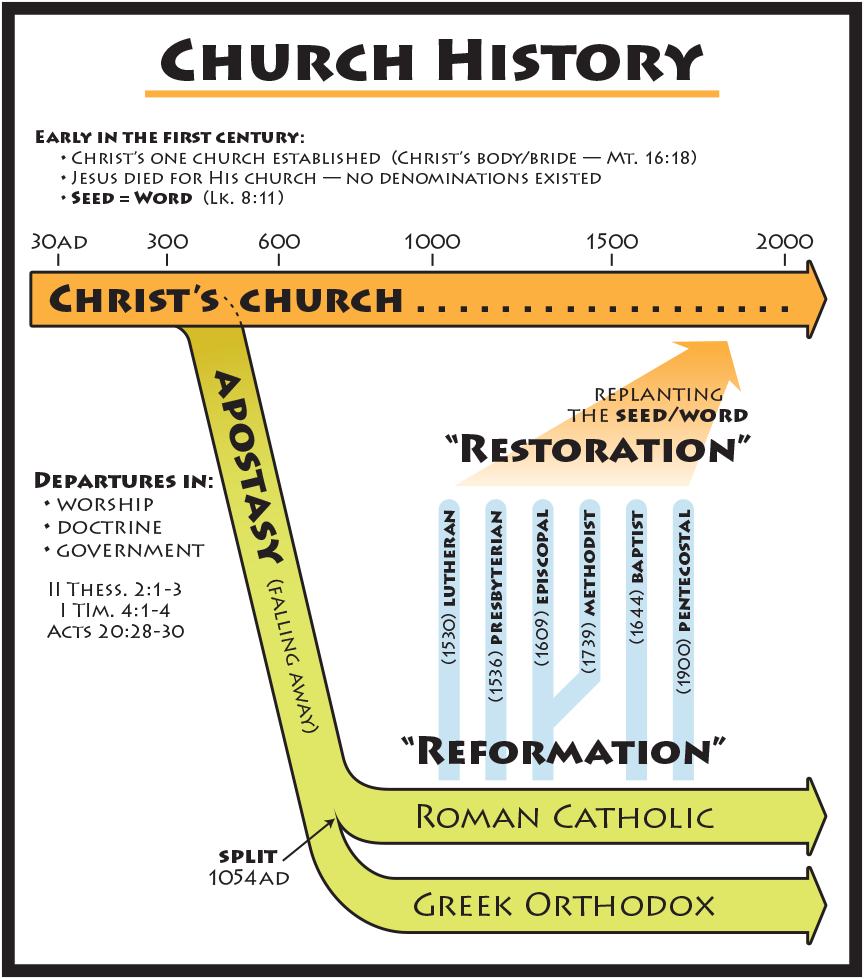
Others will find “apostasy” language too strong. That’s fine; as long as you think the doctrines listed above were not taught by the Apostles, the argument will apply.
Don’t worry, they worked it out in the end.
2 Kings 13:20 - “Once while some Israelites were burying a man, suddenly they saw a band of raiders; so they threw the man’s body into Elisha’s tomb. When the body touched Elisha’s bones, the man came to life and stood up on his feet.”
One Protestant draft reader wondered whether it could be viable to hold that the Apostles taught these doctrines, but that they were wrong. I don’t think most readers will be inclined toward this view, but here are a few brief thoughts on it.
First, the way you would know that they’re wrong would presumably be to use the Scriptures… Which were written by them. That already seems pretty bad (it smacks of Marcionism), but it actually gets worse: one key criterion for being admitted to the canon of Scripture was that a book contain nothing contrary to the faith as taught by the Apostles. So that gives us very good reason to expect that if someone thinks they’ve discovered discord between the teaching of the Apostles and the Bible, they’re probably wrong. Not only because, again, the Apostles passed on teachings they received from Christ, but because the early Church vetted out texts that disagreed with the Apostolic teaching. To take a secular analogy, it would be like someone using the testimony of the Kremlin Times to critique Mr. Putin. The odds of a poor reading are much higher than the odds of something slipping by the KGB.
Second, “that way madness lies.” It means that when Paul tells the Thessalonians, “So then, brothers and sisters, stand firm and hold fast to the traditions that you were taught by us, either by word of mouth or by our letter,” (2 Thess. 2:15) he was actually wrong. But then the written word is untrustworthy also. And now we have nothing. The same procedure could be done with 1 Cor 15:1-3 or anywhere else that appeals to having received the teaching of the Apostles.
Third, ask yourself the following. Who is more likely to know the truth of Christianity better: the disciples who received constant instruction from God Incarnate for three years, or you? If the answer is “you,” you must suppose the Divine Word to be a pretty lousy teacher.
Wikipedia has a nice list of all the ancient heresies we know about. Look through it and you will discover that nearly all the doctrines I opened with were never controversial. The few that did see dissent, such as the Antidicomarians denying the virgin birth (and therefore also Mary’s perpetual virginity) in the 3rd century, find the Church already settled in her views. So even if the doctrines were disputed by someone somewhen (and most of them were not), the very nature of the debate cuts against the Subtle Apostasy story by revealing that there was already such an overwhelming consensus that it could be handled by one or two spare theologians without recourse to an Ecumenical Council or even a local synod. The Antidicomarians are a nice example: we know about them from one author in one passage.
Keep the argument clearly in mind. It’s not that there was never dissent. If later groups react against an established teaching, it only helps my case by showing that it was in fact the established teaching, and it must have gotten there somehow. Either the Subtle Apostasy had already done its work by then without warranting a single comment, or it was part of the original Christian message. The attentiveness of the early Church makes the first answer unreasonable. Only the second remains.
https://danthedanite.substack.com/p/a-reply-to-eric-anderson-and-a-thousand
The footnotes on this were fascinating. What a great way to look at the data; I didn’t even know about the history of some of these ancient churches!