

How Do I Go To Mass?
A Short Introduction

The very first thing to do at your first Mass is give up trying to get it all in one go.1 To borrow an image that St. Ephrem the Syrian (d. 373 A.D.) uses to describe the Bible, the Mass is like an endless fountain of delicious, cold water. It is easy to despair at how much falls to the ground; but you were never going to be able to drink it all. Be joyful, rather, that you were able to drink enough to quench your thirst. You will not be able to immediately catch, let alone reflect on, every gesture and prayer in the Mass. Focus instead on what you do catch, and seek to understand it. Think of it like taking a single gold coin from a treasure chest—an excellent beginning with more to come.
What is the Mass? For some 1.4 billion Catholics today and countless more over the past 2,000 years, it is nothing short of heaven on earth. This is because the Mass contains the very essence of the Christian faith. The central message of Christianity is that God is deeply in love with you; so much so that He became man, a man, Jesus Christ. By Jesus’ life, death, and resurrection, He has made it possible for you to enter a relationship of love with God that will heal, transform, and grow you into who you were created to be. These realities are all present in the Mass. Not merely symbolically present, but really present. More on that to come.
At the most general level, the Mass has four parts: the Introductory Rites, the Liturgy of the Word, the Liturgy of the Eucharist, and the Concluding Rites.
Introductory Rites
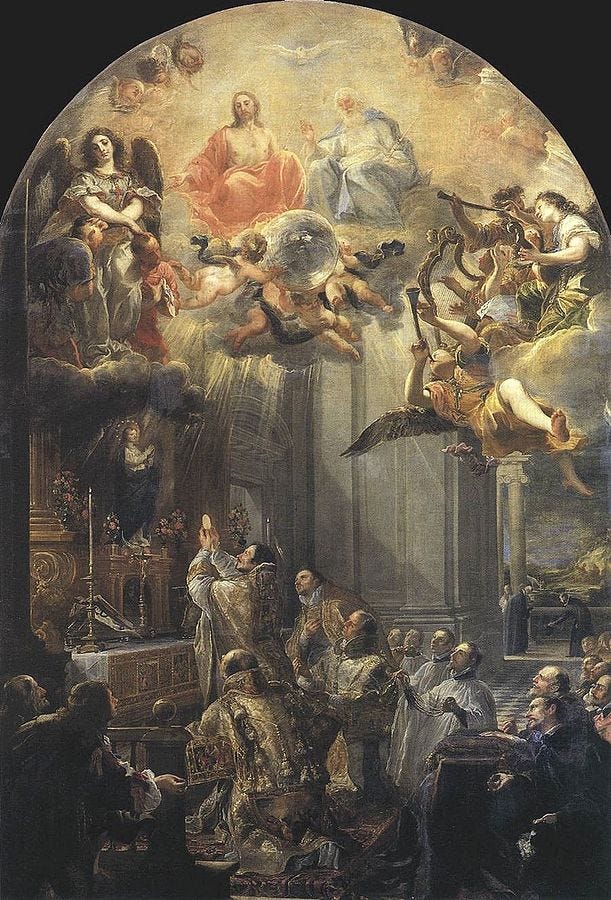
The Introductory Rites prepare us to come before God with the right posture of heart and mind. After greeting the congregation with an exchange modeled on Jesus’ greeting to His disciples (John 20:19, “Peace be with you!”), the priest leads the people in humbly acknowledging their sin and unworthiness in the face of the endless love of God. Moving from repentance to praise, the congregation recites the “Glory to God,” a prayer based on the angels’ message to the shepherds announcing the birth of Christ. After the priest says the day’s designated prayer (called a “collect”), the Introductory Rites conclude and the people sit down.
Liturgy of the Word
The next section, the Liturgy of the Word, is a feast for the soul. A passage from the Old Testament is read, a psalm is recited responsively, and a passage from the New Testament letters is read. Then the Liturgy of the Word reaches its climax: the Gospel is announced, and the people stand. The priest proclaims, “A reading from the Holy Gospel according to [Matthew/Mark/Luke/John].” Everyone makes the Sign of the Cross over their forehead (thoughts), lips (words), and heart (deeds), a sort of physical prayer that God would use the words of the Gospel to transform us to more thoroughly reflect His love. After the Gospel is read, the people sit for the homily, a short sermon.
The point of the homily is to help the congregation understand the various biblical readings they’ve just heard. The readings are set in a fixed three-year cycle, and are universal across the entire Catholic Church.2 It is up to the priest’s discretion which readings he wants to focus on, though there is a natural gravitation toward the Gospel passage. The goal is to help the faithful connect the words of the Lord to their daily lives, so they can be a living testimony to Jesus’ message of hope.
After the homily, the congregation rises together to profess their faith using the Nicene Creed, a prayer written by the Catholic Church 1,700 years ago articulating many of the core tenets of the Faith. The Liturgy of the Word then concludes with the Universal Prayer, in which the whole Church throughout the world, united with the angels and saints in heaven, stands together to ask for God’s blessing, healing, and redemption on behalf of the entire world, especially the friendless and suffering among us. The Liturgy of the Word concludes and the people sit for the Offertory, the presentation of the gifts of bread and wine, symbolizing all of the people’s spiritual sacrifices which they intend to unite with Jesus’ sacrifice on the altar.
Liturgy of the Eucharist
If the Liturgy of the Word is a feast for the soul, the Liturgy of the Eucharist is a feast for the entire person. This section of the Mass is best understood by focusing on the big picture. Recall the audacious claim that the Mass is “heaven on earth.” This is no figure of speech. Against the popular images of harps, halos, and hanging out on clouds, the Catholic Church has always taught that the essence of heaven is complete, perfect, direct, endless union with God Himself, the Holy Trinity. It’s less a place than a person, and that person is Jesus Christ. Jesus is God become man—not the appearance of humanity operated like a puppet, and not a holy man who was simply very close to God. The Christian claim is as uncompromising as it is extreme: Jesus is the one God, the God of ancient Israel.
In the Liturgy of the Eucharist, some of the final scenes of Jesus’ life are enacted, leading up to the phrases, “This is my Body,” and, “This is my Blood.” Here, we arrive at one of the most profound mysteries of the Christian religion. Where Jesus was present earlier through the reading and preaching of the Scriptures, now He is present in His entire Body, Blood, Soul, and Divinity. That is to say, though the elements still look (and taste and feel) like bread and wine, their inward reality has fundamentally and miraculously changed. They are bread and wine no longer, but have become the very person of Jesus. The Creator of the universe, who in an act of unthinkable humility became a small, helpless baby in the womb of Mary, has done something even more astounding: He has made Himself food and drink, so that we might be united to Him with our whole person. We are, after all, not ghosts driving bodies around. Our bodies are an essential part of what we are, and if we are to be fully united with God, is it so surprising that the means of creating that unity would not be merely cerebral and spiritual, but physical as well?
When Catholics say that the Mass is heaven on earth, this is what they mean. It is a taste (literally!) of the life to come, as we are united to Jesus Christ in the most intimate possible way, receiving Him into the depths of our being, into our very bodies. It is “food for the journey” to strengthen and sustain us as we continue our pilgrimage to our ultimate home and destiny: the perfect, eternal enjoyment of God.
Another important dimension of the Liturgy of the Eucharist is the fact that it is a sacrifice. Rather, it is the sacrifice, the very sacrifice Jesus makes of Himself on the Cross. The Mass is a making-present of the death of Christ. Note well that this is not to say that Jesus suffers or is crucified again. His once-and-for-all sacrifice so many centuries ago is not in need of renewal or addition. It is not that He needs help, but that we do. Every human destiny runs through the Cross; in the end we all either die with Him or die without Him. The sacrifice of the Mass gives us the opportunity to embrace His death—and therefore His resurrection—before we have to face our own.
Given all this, it is not surprising that reception of the Eucharist is restricted to Catholics who are spiritually prepared. It is not something to be taken lightly or in ignorance.
Concluding Rites
After the Liturgy of the Eucharist finishes, the Concluding Rites briefly cover any announcements, a final blessing, and a dismissal. We sing either something from the hymnal or the season’s hymn to Mary, the greatest among the saints tirelessly pointing us to Jesus and helping us love Him more by their prayers. The Mass is complete, though many will stick around to pray in the pews, or move to pray closer to where the Eucharist resides (in a special box called a “tabernacle”) twenty-four hours a day, seven days a week.
Learning The Mass
In Letters to Malcolm: Chiefly on Prayer, C.S. Lewis observes the following:
Novelty, simply as such, can have only an entertainment value. And [Christians] don't go to church to be entertained. They go to use the service, or, if you prefer, to enact it. Every service is a structure of acts and words through which we receive a sacrament, or repent, or supplicate, or adore. And it enables us to do these things best—if you like, it "works" best—when, through long familiarity, we don't have to think about it. As long as you notice, and have to count, the steps, you are not yet dancing but only learning to dance. A good shoe is a shoe you don't notice. Good reading becomes possible when you need not consciously think about eyes, or light, or print, or spelling. The perfect church service would be one we were almost unaware of; our attention would have been on God.
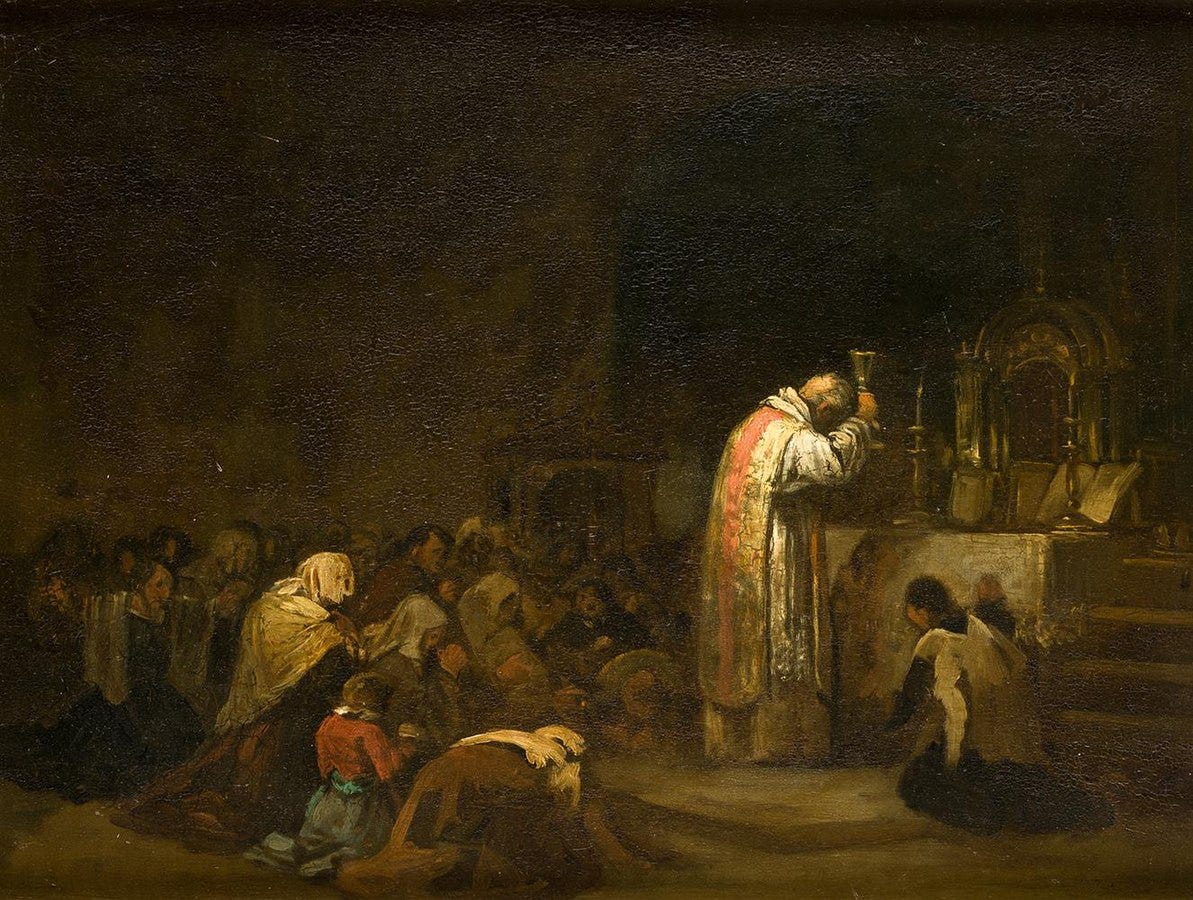
If you are new to the Mass, you are still learning to dance and not yet dancing. Do not be discouraged by the strangeness of the steps or how many times you’re caught off guard by a gesture everyone else seems to know by instinct. You will begin to pick up the motions quickly enough—you were made for this, after all. The chief thing is to start “enacting” the service as best you can. Christ has come to meet you here, and not in a general, abstract, disembodied way. He has come to meet you here in person. Attend to Him first, and the rest will follow with time. As Christ Himself has told us, “Seek first the kingdom of God and its righteousness, and all these things will be added to you.”
Words from the Saints
“They [Gnostics, a heretical sect] abstain from the Eucharist and from prayer, because they do not admit that the Eucharist is the flesh of our Savior Jesus Christ, the flesh which suffered for our sins and which the Father, in His graciousness, raised from the dead.”
-St. Ignatius of Antioch (d. ~125 A.D.)
“On Sunday we have a common assembly of all our members...The recollections of the apostles or the writings of the prophets are read...When the reader has finished, the president of the assembly speaks to us; he urges everyone to imitate the examples of virtue we have heard in the readings. Then we all stand up together and pray. On the conclusion of our prayer, bread and wine and water are brought forward. The president [priest] offers prayers and gives thanks to the best of his ability, and the people give assent by saying, “Amen”. The Eucharist is distributed, everyone present communicates [consumes the Eucharist], and the deacons take it to those who are absent.”
-St. Justin Martyr (d. ~165 A.D.)
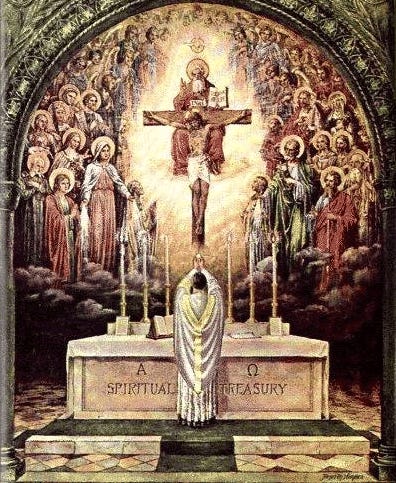
“Following His Ascension, the Lord sits with his Heavenly Father in the heavens and at the same time, He is present with the faithful Christians in the [Mass]... His Presence fills the earth... and the heavens! Thus, together with Christ, the Christian who is in the Church and communes is at the same time on earth and in heaven.”
-St. John Chysostom (d. 407 A.D.)
"Recognize in this bread what hung on the cross, and in this chalice what flowed from His side… whatever was in many and varied ways announced beforehand in the sacrifices of the Old Testament pertains to this one sacrifice which is revealed in the New Testament."
- St. Augustine of Hippo (d. 430 A.D.)
“Man should tremble, the world should quake, all heaven should be deeply moved when the Son of God appears on the altar in the hands of the priest.”
-St. Francis of Assisi (d. 1226 A.D.)
"I begin each day with holy Mass, receiving Jesus hidden under the appearance of a simple piece of bread. Then I go out into the streets and I find the same Jesus hidden in the dying destitute, the AIDS patients, the lepers, the abandoned children, the hungry, and the homeless. It's the same Jesus."
-St. Mother Teresa of Calcutta (d. 1997 A.D.)
Previous Article:

Next Article:

Back to The Guide
This guide was originally created for the Aquinas Institute for Catholic Life at Princeton University. It appears here with only minor tweaks to apply to a broader audience.
Well, the entire Latin Catholic Church; if you’re anywhere in Europe or the Americas, it’s overwhelmingly likely that that’s what you’ll encounter.
@Dylan Campbell you might find this of interest!