

Wary of Mary?
Let C.S. Lewis be your guide

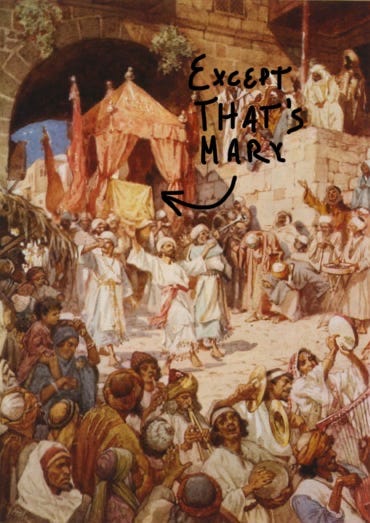
I became Catholic with reservations. One of them was Mary. I could theoretically see the sense in what the Church teaches about her, but then I would encounter videos from Catholic countries of massive crowds packing streets, processing with a statue of Mary with intense joy—or else dreadful solemnity. Both brought to mind the Jews carrying the Ark of the Covenant up to the Temple. And in those moments, even after I entered the Church, I found the Cathol-ick rising like bile in my throat. It looked bizarre, confused, wrong.
But I kept reading C.S. Lewis. My old master began to teach me new things as I returned to him with Catholic eyes, things I had apparently glossed over during previous readings. Take the introduction to Mere Christianity:
Some people draw unwarranted conclusions from the fact that I never say more about the Blessed Virgin Mary than is involved in asserting the Virgin Birth of Christ. But surely my reason for not doing so is obvious? To say more would take me at once into highly controversial regions. And there is no controversy between Christians which needs to be so delicately touched as this. The Roman Catholic beliefs on that subject are held not only with the ordinary fervour that attaches to all sincere religious belief, but (very naturally) with the peculiar and, as it were, chivalrous sensibility that a man feels when the honour of his mother or his beloved is at stake. It is very difficult so to dissent from them that you will not appear to them a cad as well as a heretic. And contrariwise, the opposed Protestant beliefs on this subject call forth feelings which go down to the very roots of all Monotheism whatever. To radical Protestants it seems that the distinction between Creator and creature (however holy) is imperilled: that Polytheism is risen again. Hence it is hard so to dissent from them that you will not appear something worse than a heretical Pagan. If any topic could be relied upon to wreck a book about ‘mere’ Christianity—if any topic makes utterly unprofitable reading for those who do not yet believe that the Virgin’s son is God—surely this is it.1
The last part felt right to me…but what about that first bit? Could there really be Christians who loved Mary with a noble love? For Lewis, a self-described “native” of the medieval world, to name something “chivalrous” is no small thing. I knew many Protestants who were happy to grant that Mary is the Mother of God, but none that loved her, chivalrously or otherwise. And what about that little world, “radical”?
This is a strange text. Lewis is clearly trying to describe two opposed lines of thought from the inside, paying due respect to each. But they come out asymmetrical—if there is a ‘mere’ Christianity that includes both groups, the second must be wrong when they accuse the first of polytheism, because Christians are not polytheists. In other words, while he leaves open whether Catholics have the right idea about Mary, he implies that the “radical” Protestants are definitely wrong, because their views imply either that some Christians are polytheists, or that Catholics are not Christians. The first is obviously false, and the second is incompatible with the explicit project of Mere Christianity, which is to exposit the universal core of Christian doctrine common to Protestants, Catholics, and (though he probably wasn’t thinking of them) both confederations of Orthodox. Lewis seems to distance himself from the fevered minority of “radical” Protestants, apart from whom we might talk about Mary naturally and at length.
I also noticed a moment in The Great Divorce that goes by so fast I missed it on my first three reads:
Some kind of procession was approaching us, and the light came from the persons who composed it. First came bright Spirits, not the Spirits of men, who danced and scattered flowers—soundlessly falling, lightly drifting flowers…Then, on the left and right, at each side of the forest avenue, came youthful shapes, boys upon one hand, and girls upon the other. If I could remember their singing and write down the notes, no man who read that score would ever grow sick or old. Between them went musicians: and after these a lady in whose honour all this was being done.
[…O]nly partly do I remember the unbearable beauty of her face.
“Is it? ... is it?” I whispered to my guide.
“Not at all,” said he. “It’s someone ye’ll never have heard of. Her name on earth was Sarah Smith…”
Who was Lewis thinking of? Who did he, for a fleeting moment, hope—and fear—this might be?
The obvious answer is the only answer.
Lewis makes this Sarah Smith a queen, complete with angels (“bright Spirits, not the Spirits of men”) and other eternally blessed humans strewing her path with flowers and filling it with song. This high reward, we are told, is because in her quiet, tiny corner of the world, she did all her little things with great love. Lewis is overawed. He goes on:
“And who are all these young men and women on each side?”
“They are her sons and daughters.”
“She must have had a very large family, Sir.”
“Every young man or boy that met her became her son—even if it was only the boy that brought the meat to her back door. Every girl that met her was her daughter.”
This Lady has become the mother of all who knew her. Those who, we might even say, sought shelter in her arms.
This troubles Lewis, who first reads it competitively.
“Isn’t that a bit hard on their own parents?”
“No. There are those that steal other people’s children. But her motherhood was of a different kind. Those on whom it fell went back to their natural parents loving them more. Few men looked on her without becoming, in a certain fashion, her lovers. But it was the kind of love that made them not less true, but truer, to their own wives.”
The Lady’s love enhances rather than shrinks the other loves of her children. The more they love her, the more their capacity for love overall increases.
“…And now the abundance of life she has in Christ from the Father flows over into [these animals].” I looked at my Teacher in amazement. “Yes,” he said. “It is like when you throw a stone into a pool, and the concentric waves spread out further and further. Who knows where it will end?...[T]here is joy enough in the little finger of a great saint such as yonder lady to waken all the dead things of the universe into life.”
The Father gives to Christ, Christ gives to her, and from her it flows over like a fountain. A life-giving fountain, even! She is full of so much life as to undo all the death in the universe, and that several times over.
This is not Mary. This is Sarah Smith. But Lewis’s first guess, left unspoken, puts us in the right frame of mind. Sarah Smith is Mary on a small enough scale for Lewis’s unsanctified heart to take in.2 He tells us as much in Letters to Malcolm:
I think the “low” church milieu that I grew up in did tend to be too cosily at ease in Sion. My grandfather, I’m told, used to say that he “looked forward to having some very interesting conversations with St. Paul when he got to heaven.” Two clerical gentlemen talking at ease in a club! It never seemed to cross his mind that an encounter with St. Paul might be rather an overwhelming experience even for an Evangelical clergyman of good family. But when Dante saw the great apostles in heaven they affected him like mountains.
Mary is not the mother of a small band of English boys and girls. She is the mother of the Savior and all his co-heirs. Lewis hammers home the enormity of this mountain in Miracles by giving us a picture of her as the one through whom all the promises and covenants of God pass on their way to the Church:
[Christianity] does not tell of a human search for God at all, but of something done by God for, to, and about, Man. And the way in which it is done is selective, undemocratic, to the highest degree. After the knowledge of God had been universally lost or obscured, one man from the whole earth (Abraham) is picked out. He is separated (miserably enough, we may suppose) from his natural surroundings, sent into a strange country, and made the ancestor of a nation who are to carry the knowledge of the true God. Within this nation there is further selection: some die in the desert, some remain behind in Babylon. There is further selection still. The process grows narrower and narrower, sharpens at last into one small bright point like the head of a spear. It is a Jewish girl at her prayers. All humanity (so far as concerns its redemption) has narrowed to that.
Lewis is alive to the gravitas of Mary in a way that I had completely missed. To me, her very unremarkableness was the most important thing about her; she could have been anyone. But to Lewis, she was no interchangeable host. What the world mistook for an ordinary girl was in fact the quiet culmination of a millennium’s labor. So many long centuries of God’s work for this: to provide a mother for his Son. She is Eve and Sarah Smith together: the “mother of all the living” (Genesis 3:20) whose life is the life of Christ. In this spirit only can we understand a hymn already used by Christians in the 200’s during their Christmas celebrations:3
We fly to thy protection,
O Holy Mother of God;
Do not despise our petitions in our necessities,
but deliver us always from all dangers,
O Glorious and Blessed Virgin.
Aside from the line about being the Mother of God, one could easily imagine a child of Sarah Smith saying this to her. Indeed, Lewis depicts Sarah Smith’s many children thronging around her to give her joyful honor. Suppose that some of her children still survived on earth. Would it be wrong for them to share the words of their fellow children who have already gone ahead to glory? It is difficult to see why the joys of heaven should be illicit on earth.
Suppose one step further, that those on earth knew about Sarah Smith’s joyful procession in heaven, and held their own small imitation of it once every year. Remember that these are good Christian men and women, who understand as well as you and I do what the glorified souls in heaven mean when they elevate her—they lift her high precisely as a doorway into the heart of Christ. But I digress.
As far as we’ve seen, Mary might be a mother of Christians. But does she have a superlative status among the followers of Christ? Lewis seems to indicate that she does. In Arthurian Torso, an obscure work published posthumously, he offers commentary on the poetry of his friend, Charles Williams. One of Williams’s key concepts is co-inherence, a kind of reciprocal love between persons by which each lives in and for the other. Lewis writes that
What the Co-inherence means is best seen in the instance of the Blessed Virgin. Christ is born (and borne) of her: she is born (and borne) of Christ…And the archtype of this is the inexpressible co-inherence of the Three Persons in one God.
In the relationship between Christ and Mary, we see the “best” creaturely reflection of the love that runs freely within the Blessed Trinity itself. (The details of the full passage require careful explanation, relegated to a footnote.4)
Lewis takes a crucial step towards perceiving the huge role of the “Blessed Virgin” for believers: he sees that she is the ideal Christian. She is the first and greatest model of Christian love, the prototype among humans of the archetype in God. And as with Sarah Smith, as with God himself from whom she draws everything she has to give, this love overflows and embraces all who come in her train.
Earlier I mentioned Eve in passing; she too shapes Lewis’s understanding of Mary, and the special role of her motherhood. In Perelandra, one of Lewis’s sci-fi novels, the protagonist Ransom spends most of the book trying to help the Venus equivalent of Eve (named Tinidril) withstand the devil’s temptations. This is Ransom’s initial impression of the unfallen First Mother of Venus:
Beautiful, naked, shameless, young—she was obviously a goddess: but then the face, the face so calm that it escaped insipidity by the very concentration of its mildness, the face that was like the sudden coldness and stillness of a church when we enter it from a hot street—that made her a Madonna.
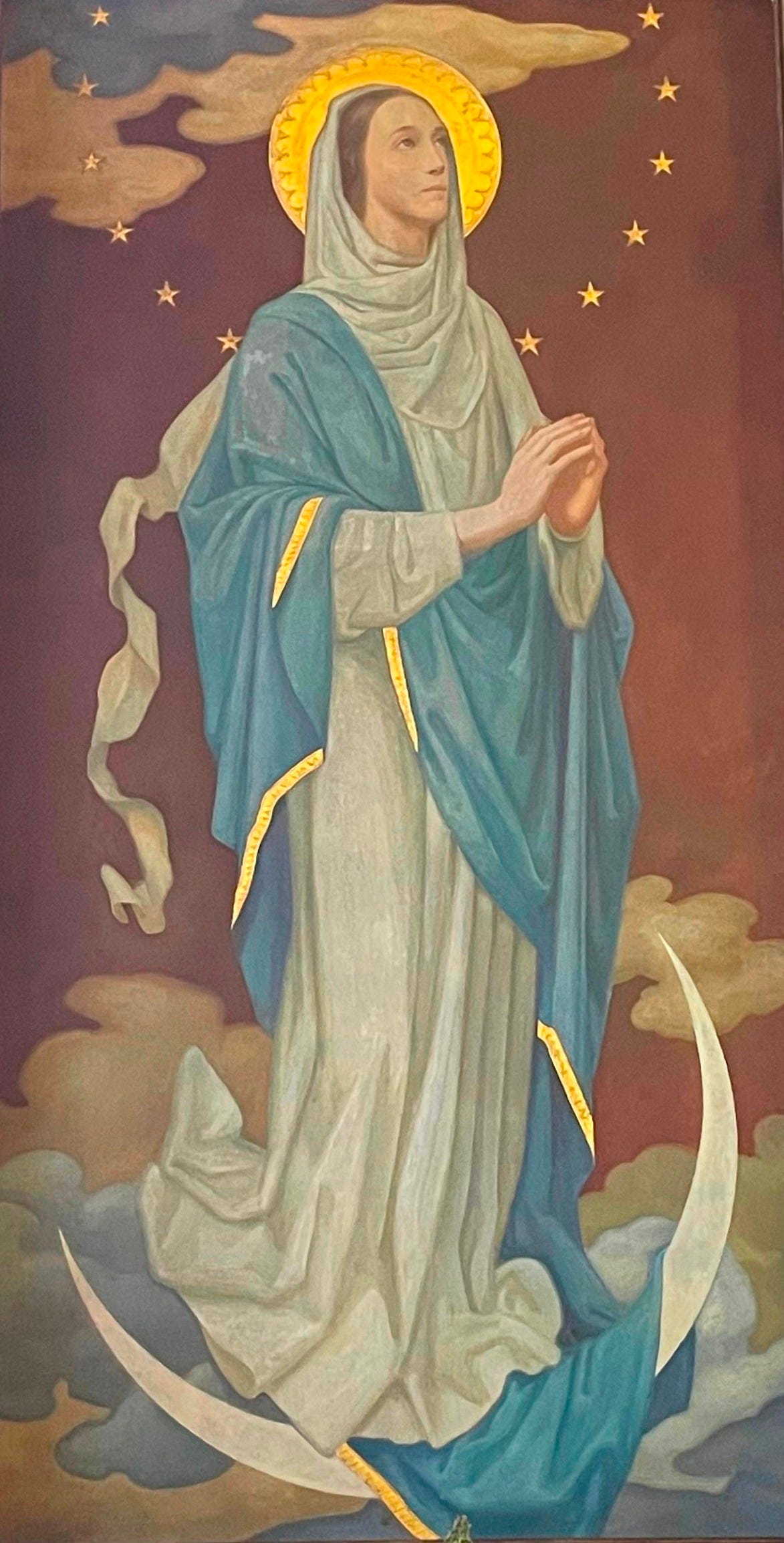
“A Madonna.” Here is a Madonna:
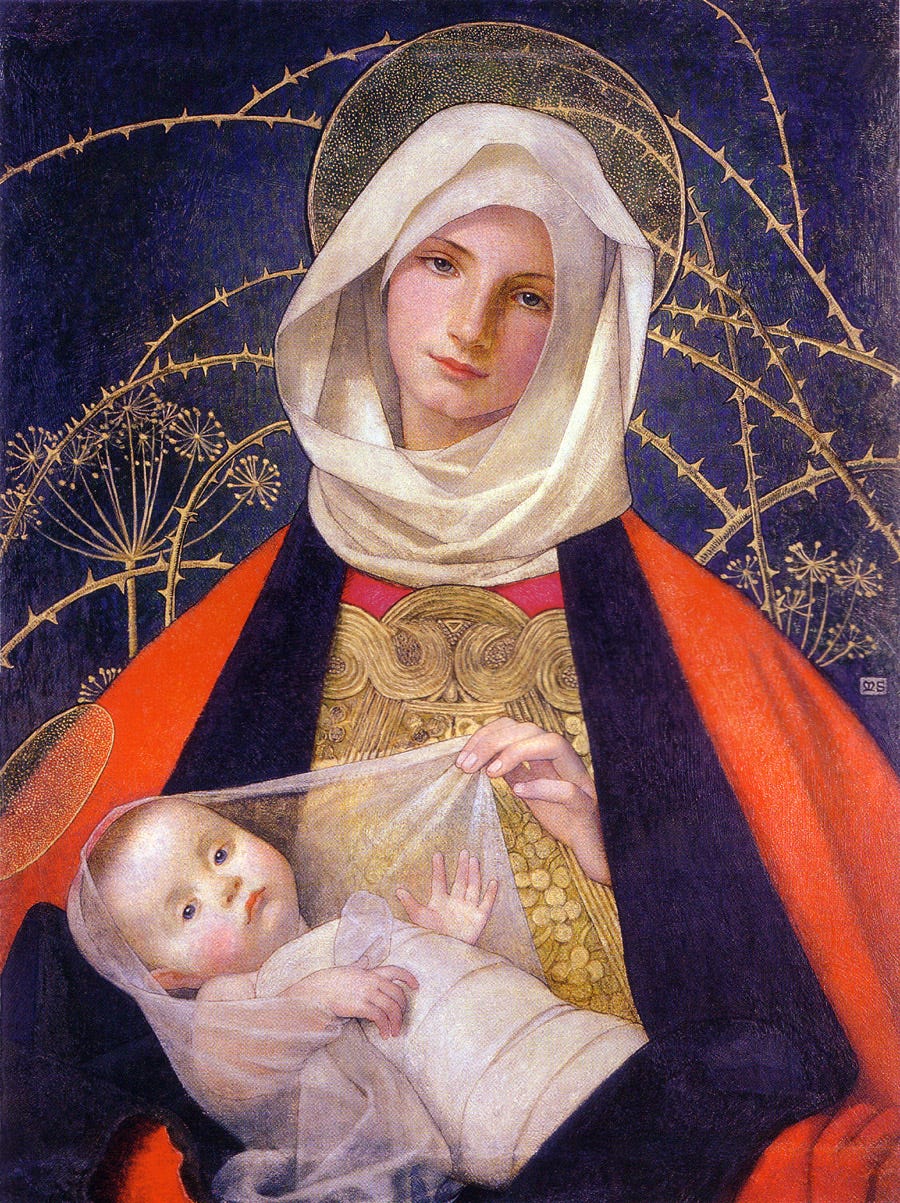
Lewis then reaches for a handful of pagan mythological characters to fill out Tinidril’s portrait, but only this one title speaks to her motherhood. Why, of all people, should he choose Mary? At this point it ought to be obvious, and his reference to entering a church is an extra hint. As Eve was the “mother of all the living,” that is, of the first humanity, so Mary through Christ has become the mother of New Humanity. In Prince Caspian, we get a sense of the massive dignity Lewis accords Adam and Eve, despite their fall:
You come of the Lord Adam and the Lady Eve,” said Aslan. “And that is both honour enough to erect the head of the poorest beggar, and shame enough to bow the shoulders of the greatest emperor on earth. Be content.
How much more honor, then, is due to the Eve of the New Covenant? The connection Lewis makes in Perelandra between Eve and Mary is very, very ancient. Irenaeus, whose teacher was a disciple of John the Apostle, writes around the year 180 A.D.:
And thus also it was that the knot of Eve’s disobedience was loosed by the obedience of Mary. For what the virgin Eve had bound fast through unbelief, this did the virgin Mary set free through faith.5
Compare with what Lewis says in “Priestesses in the Church?,”6 where he argues that if any woman were to be a priest(ess), it would have been Mary, because,
All salvation depends on the decision which she made in the words Ecce ancilla; she is united in nine months’ inconceivable intimacy with the eternal Word; she stands at the foot of the cross.
Likewise the Letter to Diognetus, written anonymously sometime between 130 and the 200’s,7 ends with this:
Bearing this tree [the wisdom of Christ] and displaying its fruit, you shall always gather in those things which are desired by God, which the Serpent cannot reach, and to which deception does not approach; nor is Eve then corrupted, but is trusted as a virgin; and salvation is manifested, and the Apostles are filled with understanding, and the Passover of the Lord advances, and the choirs are gathered together, and are arranged in proper order, and the Word rejoices in teaching the saints — by whom the Father is glorified: to whom be glory forever. Amen.
The passage describes the New Humanity through a comparison with the Genesis creation narrative. Mary is cast as the new and better Eve. Whereas at the beginning there was a virgin without sin who gave in to the Serpent’s lies, now we have a virgin totally uncorrupted by the Serpent, and as a result of her conquest, salvation is manifested to the world, and the Apostles receive “understanding.” Remember that the idea of this passage is that the New Humanity undoes the Fall; this “understanding” comes from the fruit of the true Tree of the Knowledge of Good and Evil, which is also the true Tree of Life—and that tree is the Cross of Jesus Christ. Because this Virgin overcame the Serpent through the grace of God, the fruit of the Cross is “displayed,” offered to all, beyond the Serpent’s reach forever. And in this sense, because she was the “small bright point like the head of a spear” that God thrust into Satan’s heart, she has become the mother of all those born in the life of her Son.
But you didn’t need C.S. Lewis or ancient theologians to tell you this. It’s all in the Bible. Here is Revelation 12:
A great sign appeared in heaven: a woman clothed with the sun, with the moon under her feet and a crown of twelve stars on her head. She was pregnant and cried out in pain as she was about to give birth. Then another sign appeared in heaven: an enormous red dragon…The dragon stood in front of the woman who was about to give birth, so that it might devour her child the moment he was born. She gave birth to a son, a male child, who “will rule all the nations with an iron scepter.”
…
When the dragon saw that he had been hurled to the earth, he pursued the woman who had given birth to the male child. The woman was given the two wings of a great eagle, so that she might fly to the place prepared for her in the wilderness, where she would be taken care of for a time, times and half a time, out of the serpent’s reach. Then from his mouth the serpent spewed water like a river, to overtake the woman and sweep her away with the torrent. But the earth helped the woman by opening its mouth and swallowing the river that the dragon had spewed out of his mouth. Then the dragon was enraged at the woman and went off to wage war against the rest of her offspring—those who keep God’s commands and hold fast their testimony about Jesus.
Revelation is famously dreamlike and difficult to interpret, as one image morphs fluidly into another. But it all hangs together, and Lewis has given us everything we need to understand how. There is a woman to whom the whole of salvation history once narrowed, as all twelve tribes rested on her like crowning stars. There is a woman who bears the light of the world, and, as the moon, reflects it back mirror-like. There is one who gave birth to the king of the nations. And there is a woman who labors still with the rest of her offspring, the brothers and sisters of this “male child,” against the efforts of the Serpent, the Dragon. She is Israel—she is the Church—she is Mary.
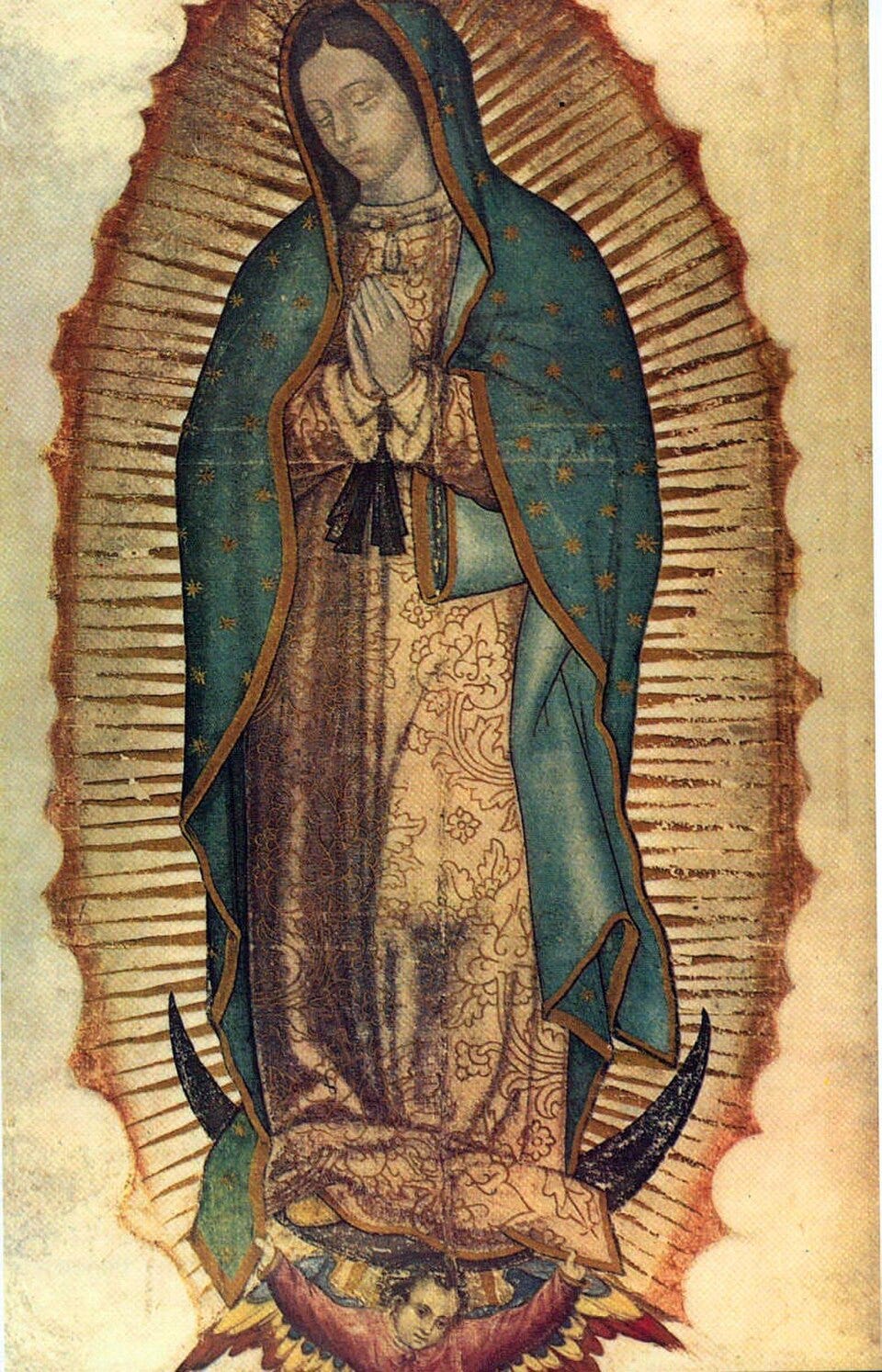
And she is more than that. There is a resemblance between Sarah Smith’s party, David’s reception of the Ark of the Covenant, and Marian processions, and it is not an accident. The parallel between Mary and the Ark is extensive and impressive. Consider:
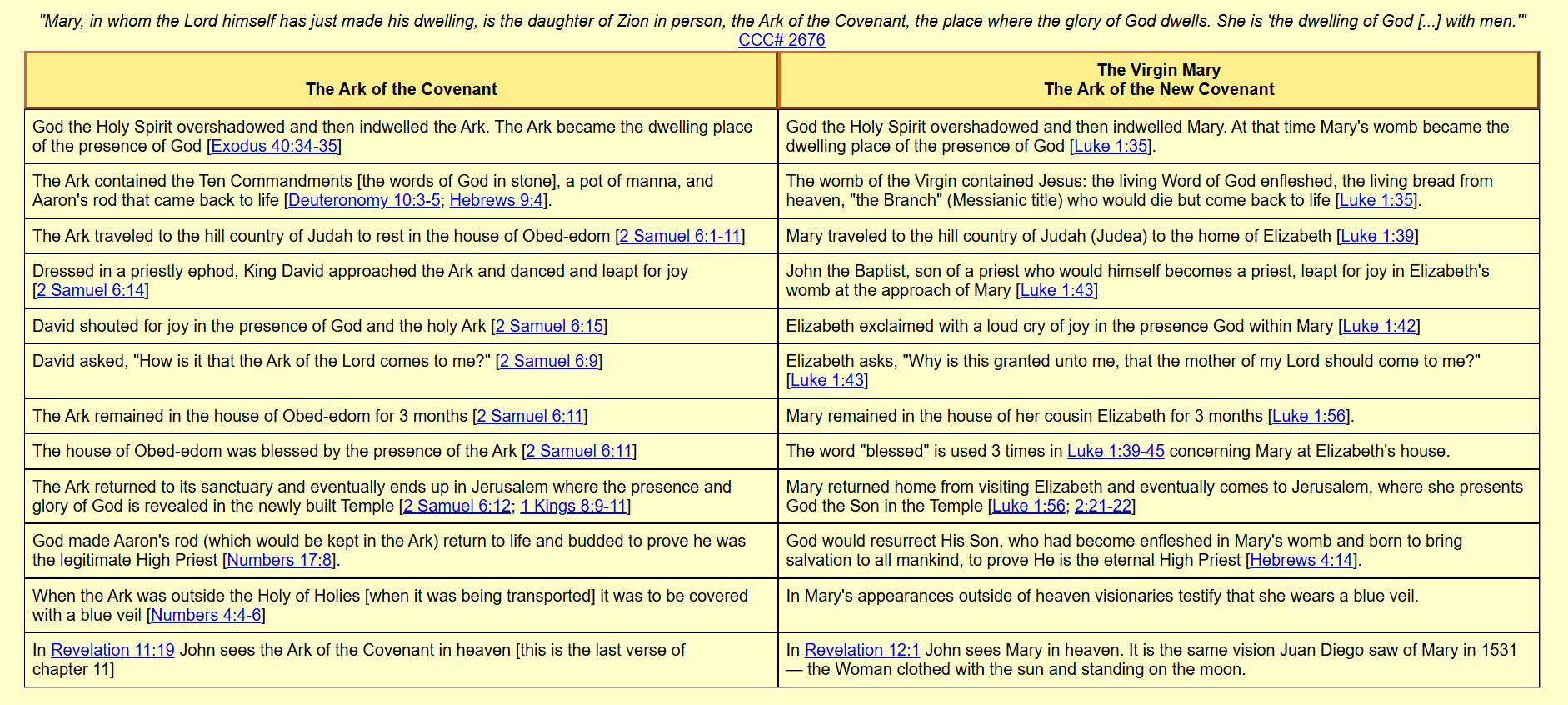
Notice that last line. The chapter division (added much later) makes the connection less obvious, but the final verse of Revelation 11 is the appearance of the Ark in heaven. The first verse of Revelation 12 is the appearance of Mary. In the imagery of Revelation, Mary is the Christ-bearer: she brings him to her children, she brings her children to him. The Ark of the Covenant carried bread from heaven, and Mary carried the Bread of Life. The Ark held the budding staff of Aaron, and Mary held an iron rod that renewed justice on earth. The Ark contained the ten words of God to Israel, and Mary contained the Word himself. No wonder John names her “a great sign.”
Lewis was alive to this connection. In Reflections on the Psalms, he shows how meditating upon Mary can illuminate Christ:
Humanly speaking, He would have learned His style, if from no one else (but it was all about Him) from His Mother. “That we should be saved from our enemies and from the hands of all that hate us; to perform the mercy promised to our fathers, and to remember his holy covenant.” Here is the same parallelism. (And incidentally, is this the only aspect in which we can say of His human nature “He was His Mother’s own son?” There is a fierceness, even a touch of Deborah, mixed with the sweetness in the Magnificat to which most painted Madonnas do little justice; matching the frequent severity of His own sayings.)
Lewis perceives that when we look upon the face of Christ, we see also the face of Mary, from whom his body came. When we hear his teaching, we also hear the voice of Mary, who taught God how to speak Aramaic and say his prayers. This does not take away from him at all, but reveals more of his heart: if we will have him for a brother, we would do well to let his mother teach us how to love him.
“Shall the religious heart live without a woman to love?”
-Fr. Dominic Legge, Order of Preachers
I think Lewis wasn’t always clear in his own mind exactly what he thought about Mary. As a lifelong student of myth, Lewis was a big believer in the importance of archetypes. The realization that Christ fulfilled the dying-and-rising god stories scattered like “good dreams” among the pagans was essential to his conversion. Two other archetypes go nearly as deep, and are even more universal: Father and Mother.8 God, of course, is the cosmic Father “from whom all families on earth take their names.” What we have in Lewis is not an explicitly developed Mariology, but a longing for the archetypal Mother, felt more acutely for having lost his own mother in early childhood. This longing is, of course, natural. If you are open to it, perhaps you (like Lewis) will find that as you meditate on Christ, his mother gently leads you closer to him, saying, as to the servants at Cana, “Do whatever he tells you.” And to that end, I leave you with an invitation in the form of a prayer:
Mary, Mother of my Lord and God,
I have not known you, but I ask you now: lead me to your Son
As you led the servants during the Wedding at Cana.
I have not loved you, but I ask you now: help me love your Son
As you love Him with a pure mother’s heart.
I have not wept with you, but I ask you now: pierce my heart with the sword that pierces your own,
That your Son’s Crucifixion may be mine.
And God, supreme and only end of all things,
If I err in this prayer, forgive me and teach me better.
Only give me more of Christ.
Amen.
Previous Article:

Next Article:

Back to The Guide
That last bit, by the way, is wrong. Mary has played an essential role in evangelizing pagans, particularly those in the Americas. Millions upon millions were converted by the miraculous image of Our Lady of Guadalupe, even while the Faith in Europe was being torn to tatters.
Since Lewis is both author and narrator in The Great Divorce, this is a confession of his own incapacity to withstand an encounter with Mary—let alone Jesus, who is incomparably greater.
This specific translation is a little younger than the original used in the oldest manuscripts we have, but I chose this one since it’s what you’ll find printed in prayer books today.
Here is the full, unabridged passage:
What the Co-inherence means is best seen in the instance of the Blessed Virgin. Christ is born (and borne) of her: she is born (and borne) of Christ. So in humanity as a whole there is not merely an interchange of symmetrical relations (as when, A being the brother of B, B is also the brother of A) but of those unsymmetrical relations which seem incompatible on the level of ‘rational virtue’. Each is mother and child, confessor and penitent, teacher and pupil, lord and slave to the other. Each is his neighbour’s priest—and victim. Each, if you fix your eyes on him, becomes the exclusive end for whom all the other exist—
                                                                           there men
                                 were known, each alone and none alone
                                 bearing and borne.
And the archtype of this is the inexpressible co-inherence of the Three Persons in one God.
Taken out of context from the rest of Lewis’ thought, this might seem to undermine my claim that he recognized Mary as unique—doesn’t he as much as say that these relations go both ways—so that she’s my mother, but also (somehow) my daughter? No; for Lewis, that sort of absolute equality is quite literally the design of hell. A passage from the end of Perelandra gives heaven’s policy in striking terms:
[The New Creation] is loaded with justice as a tree bows down with fruit. All is righteousness and there is no equality. Not as when stones lie side by side, but as when stones support and are supported in an arch, such is His order; rule and obedience, begetting and bearing, heat glancing down, life growing up. Blessed be He!
There is reciprocity, but not in a way that eliminates different stations. Actually, difference in station makes building the Church possible; if some stones weren’t higher than others, there would be no building at all, but only a mass of rocks lying on the ground. The higher depends upon the lower, and the lower finds its purpose in supporting the higher. Only thus can you build an arch. And actually, the Arthurian Torso passage itself gives the key: the Son of God formed Mary, and he also was formed in her. Yet no one would take this to mean that he was no longer Creator and she a mere creature. These “symmetrical” relations do not erase differences, but wash them in the colors of glory.
Against Heresies, Bk II, Ch. 22.4. This comes at the end of the section, but the whole paragraph is very much worth a read.
I am indebted to Arthur J. Mastrolia’s Ph.D. dissertation, “Uncovering a Marian Attitude in the Works of C.S. Lewis” (University of Dayton, 1998) for bringing these two passages to my attention. To my surprise, this otherwise excellent dissertation entirely misses the Sarah Smith connection. I present it to you here for what is, to my knowledge, its first analysis as a Marian moment!
Ecce ancilla: From the Vulgate (ancient Latin) Luke 1:38 — “Ecce ancilla Domini: fiat mihi secundum verbum tuum.” “Behold, [I am] the handmaid of the Lord: let it be done unto me according to thy word.”
Letter to Diognetus, Ch. 12. Many historians think the last two chapters (i.e., 11 and 12) were added after the rest of the letter, perhaps as late as sometime in the 200’s, which is why I widened the date range in the main text. Some think it may have been written by St. Hyppolitus, which would be extremely cool, since he is one of the first theologians of the Trinity in Church history.
‘Your father is an image of the Lord of Creation, your mother an image of the Earth…’
Hindu text quoted in the appendix to The Abolition of Man. The theme of the Masculine and the Feminine as fundamental archetypes, particularly in the specific form of Father and Mother, recurs throughout his works.
In “Myth Became Fact,” he says that “A man who disbelieved the Christian story as fact but continually fed on it as myth would, perhaps, be more spiritually alive than one who assented and did not think much about it.” Lewis, of course, believed Christianity was factually true, but he also “continually fed upon it as myth.” I believe it is this perpetual meditation upon the deep things of the Gospels that explains his remarkably perceptive treatment of Mary. We might even say that, in a sense, he was imitating her own capacity for “treasuring all these things in her heart.”
Eric,
I read your essay with real appreciation. Not only because it is beautifully written, but because I can feel the sincerity behind it. You are not trying to score easy points or flatten Protestant concerns into caricature. You are describing, from the inside, how something that once seemed alien or even troubling to you began to appear more beautiful through Catholic eyes. I respect that. And though I have not followed you back to Rome (for I believe I have mentioned before to you that I was baptized Catholic), I do not condemn you for doing so.
I also think you are right about something important: many Protestants have not known what to do with Mary. We can be so anxious to avoid excess that we end up saying far less than Scripture itself says. Mary is blessed among women. She is the mother of our Lord. She receives the Word of God with obedient faith. She stands at the hinge of salvation history. In that extraordinary line from Miracles, Lewis captures this beautifully: all of humanity, as concerns redemption, narrows to “a Jewish girl at her prayers.” That is not a small view of Mary. It is reverent, serious, and full of wonder.
So yes, I think Lewis lifts up Mary. He does not treat her as incidental. He sees her as uniquely chosen, uniquely obedient, and uniquely close to the mystery of the Incarnation. And I agree that many of us Protestants could learn from that. We should speak of Mary with more gratitude, more biblical attentiveness, and perhaps more awe.
But I am less persuaded that Lewis leads us all the way to Catholic Marian devotion or doctrine. The passage from Mere Christianity seems especially important here. Lewis does not affirm the Roman Catholic position; he carefully names it as controversial. He recognizes the chivalrous love Catholics feel for Mary, but he also recognizes the deep Protestant concern that the distinction between Creator and creature may be imperiled. His tone is respectful, but also cautious.
This is where I think your essay is both compelling and, at points, a bit overextended. The Sarah Smith passage in The Great Divorce is fascinating, and I can see why you read it in a Marian direction. The narrator’s startled “Is it?” almost certainly suggests Mary. But the reveal that it is not Mary seems central to the scene. Lewis is showing us the hidden glory of an ordinary saint whose love, in Christ, has become unimaginably fruitful. That may echo Mary, but it does not necessarily establish a Marian theology. It may simply show that sanctity itself is far greater than we imagine.
Likewise, Lewis’s medieval imagination gives him a much richer appreciation for Mary than many modern evangelicals possess. He is not embarrassed by the title “Blessed Virgin.” He is alert to her role in the drama of redemption. He can see how meditating on Mary may illuminate Christ. But reverence is not the same as dogma, and literary sympathy is not the same as Catholic doctrine.
For me, the decisive question is not whether Mary should be honored. She should. The question is whether the forms of Marian devotion that developed in Catholic piety are required, warranted, or pastorally wise for all Christians. That is where I remain Protestant. I want to honor Mary because Scripture honors her. I want to call her blessed because the gospel teaches me to do so. I want to see in her faith a model of discipleship. But I remain cautious about prayers to Mary, Marian processions, and doctrines that seem to ask more of the Christian conscience than Scripture clearly requires.
Still, your essay helps me see something I do not want to lose: Protestant caution can become Protestant poverty. If my only instinct is to say, “Not too much,” I may fail to say enough. Mary is not a threat to Christ when she is received as Scripture presents her: the Lord’s servant, the mother of Jesus, the woman who says, “Do whatever he tells you.” In that sense, every faithful reflection on Mary should end where Mary herself points us—to her Son.
So perhaps Lewis is a helpful guide after all, though maybe not in quite the way you suggest. He teaches Catholics to be patient with Protestant fears, and he teaches Protestants not to be stingy with Marian honor. He refuses to let Mary become either a battleground or an afterthought. He keeps the wonder of the Incarnation at the center, and from that center he allows Mary to appear in her proper light.
That is a place where I can stand with you, even if we still disagree. I can give thanks for Mary. I can learn from her obedience. I can admire the beauty Lewis saw in her. And I can do all of this while still believing that Christian devotion must finally and directly rest in Christ alone, the one Mediator, the Word made flesh, the Son whom Mary bore and worshiped.
With affection and gratitude,
Judson
This is legitimately one of the best articles I’ve ever read.