

Don't Settle for Salvation
Christianity is better than we dared hope

I’ve been thinking recently about the Romans Road. Not the road to Rome (I think about that all the time); the Romans Road is a formula designed to walk someone through the Gospel in a simple, compelling way using seven verses from the Epistle to the Romans. You can find it in full here, but the gist is:
-Your sin has separated you from God and set you on a path to death.
-God sent Jesus to save you with his death.
-If you accept Christ as Lord, you can receive the forgiveness on offer and have peace with God.
What’s been occupying me is how underwhelming I now find this. Once, I was drilling it with flashcards and practicing the hypothetical conversation with my friends. I even used it in real life a few times (it never led to conversion).1 Now it just feels like a letdown. And not the beautiful kind.
What would you say is the most central, important doctrine of the Faith? This is not a hypothetical question; answer it for yourself before continuing. What is the second? Maybe write it down or say it out loud to lock it in.
Did you say “the forgiveness of sins based on the death and resurrection of Christ”? That’s what I would have said, once.
When I was a student at Princeton Theological Seminary, I began studying Catholicism in earnest. Somewhere in my first year the plausibility of Catholicism passed a tipping point, and discovering whether it was true or not became an overriding concern. During this time, I began asking my fellow seminarians, Lutheran, Reformed, and Methodist alike, what they would consider the most important doctrine. Many of them didn’t have a ready answer, but those who did generally said something along the lines of what I wrote above: Jesus died so your sins could be forgiven. Some mentioned the Resurrection, too.
Do you know what my Catholic friends said? They said it was the Trinity. The second was the Incarnation. Somewhere under the latter fall the events of the life and death and surprise second life of Christ.
This floored me. It seemed so simple, so obvious. So in line with the best insights of Calvin! The most important thing is God Himself in His own interior blessed life, not what He does for me. God, God above all, God and only God. The second moment brings creation into the picture: God becomes man. Even here, we have not reduced the Incarnation to a debt-paying mechanism. For Catholics the Incarnation is the center of reality, the event and Person that remakes creation down to its roots.2 If God takes on matter, matter is elevated. If He takes on a living body, life is elevated. If He takes on a human soul, humanity is elevated.
Does the death of Christ pay our debts? Yes! Does his resurrection guarantee our own? Yes! But we’re just at the threshold, standing on the edge of the mountain with our skis halfway over the edge, wobbling on the precipice of the divine mysteries.
Christ saved you from sin, yes. But what did He save you for?
If I were going to create my own version of the Romans Road, or its shorter and better-loved sister, the Four Spiritual Laws, it would crescendo into a grand explosion with 2 Peter 1:3-4.
His divine power has given us everything we need for a godly life through our knowledge of him who called us by his own glory and goodness. Through these he has given us his very great and precious promises, so that through them you may participate in the divine nature, having escaped the corruption in the world caused by evil desires.
Notice: Escaping the corruption in the world is merely groundwork for the real treasure: participating in the divine nature.
Participating in the divine nature?!?!?!?!?!?
Yes.
You were not created to have your sins forgiven. You were not created to enjoy earthly life just x1000 better. That’s what the medievals called Limbo. You were created to enjoy the very inner life of the Trinity.
In St. Paul’s words, “we all, who with unveiled faces contemplate the Lord’s glory, are being transformed into his image with ever-increasing glory, which comes from the Lord, who is the Spirit.” Now, we see “only a reflection as in a mirror; then we shall see face to face. Now [we] know in part; then [we] shall know fully, even as [we are] fully known.”
The language of the medieval theologians followed this thread and spoke of man’s final end as the “beatific vision;” the Church Fathers followed St. Peter and spoke of “divinization” or “theosis.” In the end, though, it all comes back to the teaching of Our Lord.
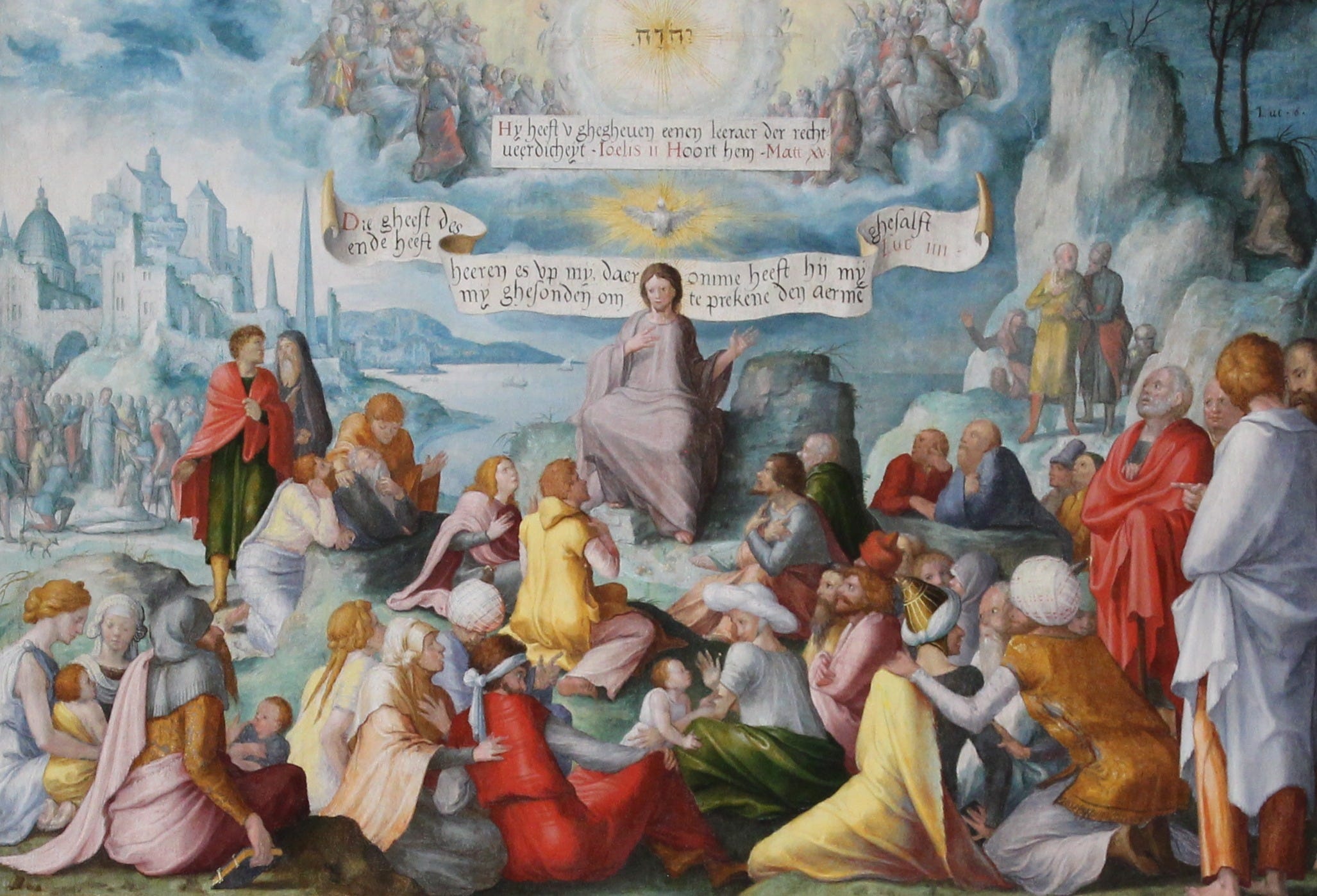
Where in Scripture do we get a compact summary of what God expects from us? Many, I suspect, would say it is the 10 Commandments. Certainly, Americans seem obsessed with getting them up everywhere we can. Do you know what the Two Big A’s3 said? The Beatitudes. For Augustine, the Beatitudes form the “charter for the Christian life.”4 They sketch the path from worldly living up to the summit of divine love.
“Blessed are the poor in spirit,
for theirs is the kingdom of heaven.”
When we recognize our poverty before God, our utter inability to muster anything we can claim for ourselves and consequent need for grace, only then are we able to begin the spiritual life. So far, the Roman Road and Four Spiritual Laws are keeping pace, as they too begin by recognizing our urgent helplessness.
Blessed are they who mourn,
for they will be comforted.
Classically, this has been taken primarily to refer to sorrow for our sins. We first recognized our need for God; now we repent of our sins, which God promises to reward by embracing us. Turn, and be healed. At this point, we’ve come to the end of the Romans Road and the last of the Spiritual Laws. Far from the “happily ever after” these approaches offer, the life outlined by the Beatitudes is only just beginning.
Blessed are the meek,
for they will inherit the land.
When we submit to God’s just correction, when we accept all things (even evil done to us) with equanimity flowing from our hidden life in Christ, we reach a kind of self-possession and steadiness that can’t be shaken. We’ve taken a definitive step beyond my old evangelism tools.
Blessed are they who hunger and thirst for righteousness,
for they will be satisfied.
We’re not just going for spiritual stability. God wishes us to burn for Him. When we seek Him with all our heart, He promises that He will be found, and we will be satisfied. Our labor is not in vain. There is, by the way, an overt Eucharistic allusion here, as explained in this footnote.5
Blessed are the merciful,
for they will be shown mercy.
Follow the progression thus far: we acknowledged our need, turned to God, repented of our sins, and found steadfastness of soul in a land we cannot be evicted from. This brought us to a crucial turning point, as we began to share in God’s own righteousness and action. Now we imitate God concretely. Having had our sins forgiven, we turn to forgive others. The prodigal is welcomed home; now he must learn to be like the father. “Forgive us our trespasses, as we forgive those who trespass against us.”6
Blessed are the clean of heart,
for they will see God.
Here it is. Everything has led to this moment. It might not sound like much, but remember that in the Old Testament, no one could look on God and live. We are stepping into a bright abyss, beyond all markers and guideposts. When we became imitators, indeed sharers in the divine mercy, we became conduits of God’s own love. That love, or rather Love, empowers us to exceed the ordinary bounds of human capacity, and we are made able to love God in a truly divine way. We approach Him through His own Love.
Do not let this go by quickly. Follow the logic, and the Trinitarian mystery will begin to reveal itself. We have received God’s Righteousness, not merely as a name but as a new principle of life. It is no longer I who live, but Christ who lives within me. Thus we turn back to the Father to offer Him the love of the Son. In case you’re not up on your Trinitarian theology, that’s the manner in which the Holy Spirit proceeds.
The Holy Spirit is the “pledge of love” between Father and Son. He proceeds from the “kiss” or “sigh” (Latin suspiro) of love between the first two Persons. So when we love God with God’s own Love, we are replicating, in miniature, the very interior procession of Persons within the Trinity. The Trinity “happens again” inside us. Or, if you like, the Spirit’s presence in us “loops us in” on God’s interior dynamics of divine gift and self-gift. You may behold God, not as an appreciative spectator beholds a sunset or tsunami, but as a “partaker in the divine nature.”
Forget the Romans Road. We’re past the Milky Way at this point.
Blessed are the peacemakers,
for they will be called children of God.
You might have thought things would end with seeing God. But this is not so. To truly imitate the Son, for Christ to live through us, it is not enough to be satisfied within ourselves. We have come to share in the Trinity—now we will share in the Incarnation. Like the Son, we go out into the world to reconcile it to God, Christ making his appeal through us. Then we can say with St. John, “See what kind of love the Father has given to us, that we should be called children of God; and so we are” (1 Jn 3:1). His Sonship becomes truly our own when we share in his mission.
Blessed are they who are persecuted for the sake of righteousness,
for theirs is the kingdom of heaven.
Of course, the way of Christ entails suffering and death. Yet if we share in a death like his, we shall be raised to a life like his. And so we receive what was promised to us from the beginning.
The picture gets even richer, if you can believe it. The saints, and especially Mary, play a key role here. St. Irenaeus, disciple of St. Polycarp, disciple of St. John the Apostle, tells us that “the glory of God is a human being fully alive.” Being raised to the heights of divine sonship does not erase you, but makes you more fully yourself. The starry array of saints proves this. As each conformed more closely to Christ, their individual quirks, talents, and interests did not vanish but intensified, and the Church’s entrusting different domains of human life to the care of particular saints reflects this.
You will only find yourself when you give yourself over to the Trinity and are born again in imitation of the Son’s Incarnation.
Probably some Protestant readers, up until the last paragraph, have been wondering what about this is uniquely Catholic. Can’t it just be incorporated into Reformed, Lutheran, Evangelical, or Charismatic theology? Maybe, maybe not. Luther and Calvin, I think, have too weak an understanding of justification to give this its full due. That’s not really the point, though.
Assume that all this is generally compatible with Protestantism. The painful question is, Why weren’t you taught this? Even if it can be made to take root, why does it have to come in like an invasive species? In fact, if the two visions are compatible, that’s an even more difficult question, as there seems to be no reason to downgrade from this vision to one that centers upon the mere forgiveness of sins. My speculative answer is going to anger some, but it seems the most plausible explanation to me.
I think the reason is that Protestantism, as a system, has always been more interested in what God gives man than in God Himself.
And yes, I mean all Protestant systems. It’s baked in from the beginning.
When I said earlier that my discovery of the Trinity’s centrality was in line with the best insights of Calvin, I was referring to the God-centric impulse that runs throughout his work. But it is not the dominant theme. A harmony, yes, but the controlling melody is not the doctrine of God; it’s the assurance of salvation for individual Christians. The absolute sovereignty of God follows as an immediate consequence, because the God who irrevocably decrees human destinies from his dark whirlwind will surely accomplish his purposes. If He has elected you, that is simply the end of the matter. And so you see the direction of inference: from human anxiety to the nature of God.
“Very well,” you might say, “you’ve shown me I have been too interested in myself. Perhaps this is a defect I share with Calvin. But it simply doesn’t follow that I should cease to be Protestant.”
If this were a mere historical accident, I might grant the point. But I do not think it is. The Romans Road mindset recurs too frequently, too universally, to be anything other than the inner logic of a system working itself out. For my part, I am still trying to understand what the core of that inner logic is. It is, in a way, getting at the question of what the difference is between Protestantism and Catholicism as systems, the question whose answer a very close Protestant friend of mine referred to as my “white whale.” Well, call me Ishmael.7 But just because I haven’t caught my white whale, don’t think that makes it any less real. Whether it’s pragmatism, individualism, or some other -ism without a name, it is deep in Protestant theology, deep enough that it is as ubiquitous in the original movement as its descendants today. It’s in the DNA.
As always, I polemicize out of love for the things I’m criticizing. All Protestant traditions have their moments of deep friendship with the Lord, and are credited by exceptional individuals bearing the fruits of the Spirit. Tim Keller, for instance, has an absolutely delightful sermon on the Trinity (though its strength mostly comes from being based on a C.S. Lewis passage). That’s why I’m criticizing systems.8 The Protestant systems do not naturally exalt the Trinity and the Incarnation as the highest elements of Christian revelation because they are naturally more concerned with man’s experience of God than God in Himself. Even so, they need not be demolished; I have argued elsewhere, and will continue to argue, that all strains of Protestantism have vital insights into Christianity, and far from being destroyed, will only be preserved from the oblivion of time if they are brought into communion with the Catholic Church. The living water flowing through them will only become sweeter, clearer, and more refreshing for having filtered out the silt.
Yet systems will be what they are, at least for the time being. There is a more pressing question before us: What will you do? If you’re floored by the prospect of participating in the very inner life of God, if you’re delighted that Christianity is so much better than you ever dared dream, believe me when I tell you that there’s more where that came from. You have lived your Christian life on the threshold—perhaps it is time to come inside.
Previous Article:

Next Article:

Back to The Guide
I would like to talk about the differences between Catholic and Evangelical modes of sharing the faith another time. I do think there was probably an era of American history where tools like this were more effective; I also think that day has come and gone.
In fairness, both confederations of Orthodox would agree with this—although between drafting and publishing, I listened to John Behr give a talk in which he commented that the “Trinity-and-Incarnation-first” approach is a pernicious Latinism he’s spent decades “unlearning.” So maybe the Eastern Orthodox are not settled on this score; I hope for their sake that Behr is an outlier.
Augustine and Aquinas. They’re the S-Tier A’s. A-Tier A’s are Athanasius and Anselm. Aristotle too, if he counts. B-Tier A’s include Albert the Great and Alfonsus Ligouri. C-Tier belongs to Abelard. F-tier obviously goes to Arius. I will take no feedback.
This phrase comes from Morality: The Catholic View by Servais Pinckaers, a Belgian Dominican. It is short and accessible, without sacrificing theological excellence. I cannot recommend it highly enough.
Isn’t it strange that Jesus should use the phrase “hunger and thirst” when He otherwise declines metaphor altogether in the Beatitudes? Wouldn’t “long for” have done just as well? Familiarity makes us neglect the strangeness of this turn of phrase, but once noticed it demands explanation. The answer comes from Paul, who has the insight in 1 Corinthians 1:30 that Christ Himself is our righteousness. In the Eucharist, we receive this Righteousness as both food and drink. It has been said that usually, when we eat food, it is transformed into us, but with the Eucharist, we are transformed into it. It makes us share in the Righteousness of God, in the very being of Christ Himself. Those who hunger and thirst for righteousness will indeed be satisfied by God’s “daily bread.”
Aquinas (following Augustine) says that the Beatitudes can actually be mapped, in order, onto the petitions of the Lord’s Prayer. This is one of the more obvious ones, but they all fit. It witnesses to the supernatural splendor and coherence of the moral vision revealed in the New Testament. See Summa Theologiae, IIa IIae, Q83, A9, Reply to Obj. 3.
That same friend graciously read drafts of this post and gave me invaluable feedback. Thanks, Ben!
Also because it seems like a fool’s errand to argue against the thought of individual Protestant thinkers, since any given interlocutor might just say, “Well, I disagree with him too on that point.” Or, “On this point, I agree with the Catholics.” When discussing individual thinkers or ideas in isolation, we might think we’re being presented with an array of choices that we simply have to do our best with. But there is a more fundamental choice that this way of proceeding obscures, and that is the choice I am always trying to press. And there are some thinkers who get closer to the Catholic view. Ben (see footnote above) has impressed upon me that Jonathan Edwards is an exception to this rule, and plausibly Karl Barth too. I suspect he may be right about Edwards and wrong about Barth. It’s a moot point, though, because neither left ecclesial traditions. There are almost no Barthians in pews—they’re all in pulpits or classrooms. There might be a few Edwardsians out there; one would have to carefully comb through the P.C.A. to find them out.
I loved this piece, very well done. This lays bare the problem with evangelical holiday services.
I am always confused by Christmas Eve services at evangelical churches which focus on Christ's redemptive work on the cross. This misses the point of Christmas as an individual holy day. The incarnation not atonement should be the focus of Christmas. They are related for sure but to the over emphasis on salvation shows the deep seated overemphasis on "personal salvation"
"Whether it’s pragmatism, individualism, or some other -ism without a name, it is deep in Protestant theology, deep enough that it is as ubiquitous in the original movement as its descendants today. It’s in the DNA."
I am fairly convinced it's what Paul Hacker calls "reflexive faith" in his book "Faith in Luther: Martin Luther and the Origin of Anthropocentric Religion": the peculiar doctrine that belief in one's individual salvation is the key to salvation itself. It's the animating principle behind essentially all the Protestant distinctives, and once I saw it I cannot unsee it, everywhere from the stereotypical question "do you know whether you're saved", to the liberal Protestant existential dialectic between faith and skepticism, to the fundamentalist recoil at any hint of doubt as a sure sign of damnation.
It perfectly explains why even Protestant spirituality revolves around assurance of salvation, justification, etc, in a way completely out of step with the Catholic tradition.
It certainly was the point I felt the most dissonance with Catholicism before my conversion (from a vague Protestant mishmash that includes everything from evangelicalism to confessional Lutheranism, but that's a story for another day), as well as the point I feel the most dissonance with Protestantism now.